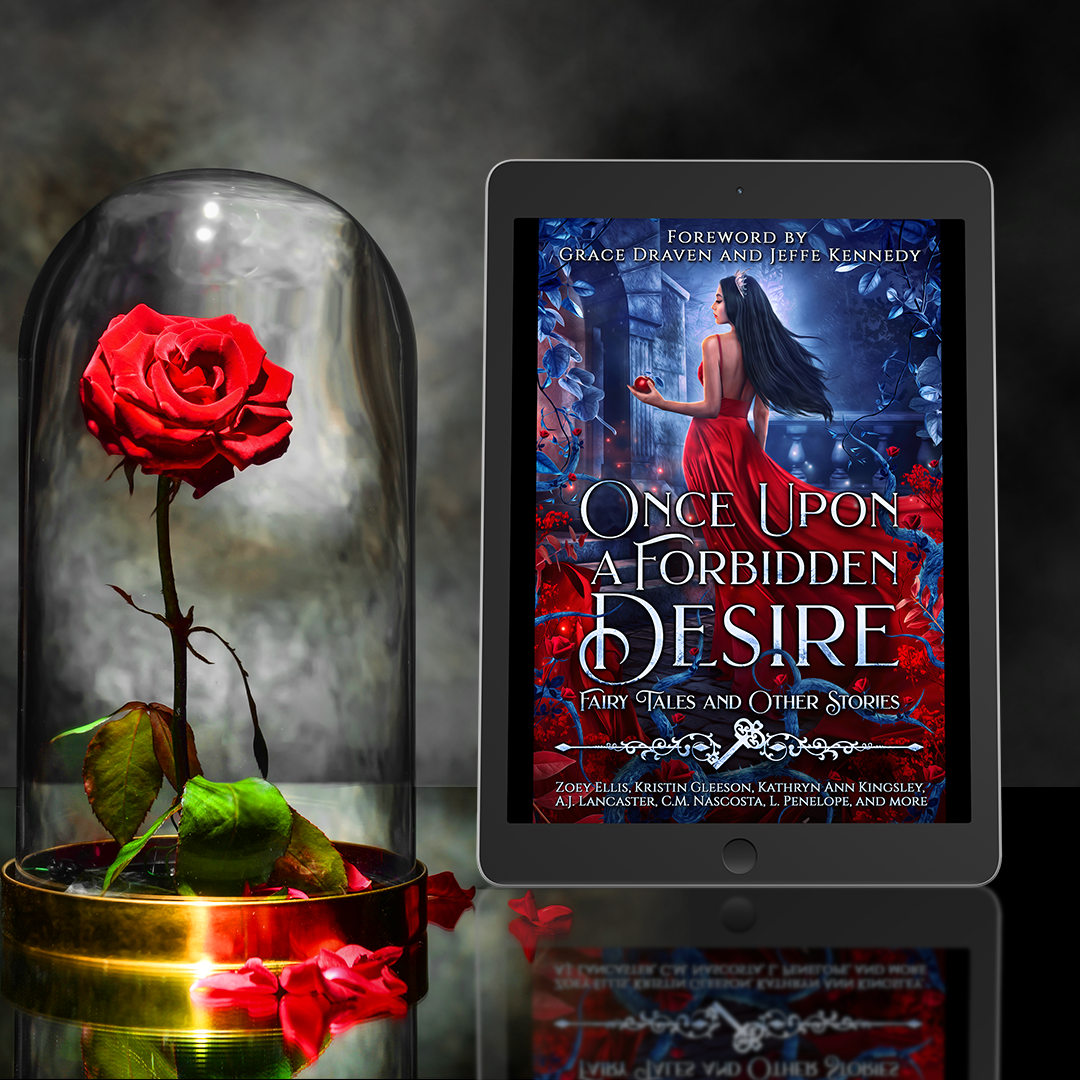
I’m excited to announce that I’m part of an anthology of fantasy romance fairytale retellings releasing later this year. This is my first time writing a short piece and participating in such a group project, and I had a ball (heehee) of a time doing it. More details on my own story to come.
There are a huge number of talented authors taking part, showcasing the breadth of this subgenre. I’m so excited to read them all!
When it comes to true love, rules are meant to be broken …
Dark forests and locked doors, poisoned apples and forbidden lovers … Bold heroines and swoon-worthy heroes break all the rules in this enchanting anthology of the fairy tales you thought you knew.
Once Upon A Forbidden Desire features 20 enticing fairy tale retellings by a diverse selection of fantasy romance authors. From sweet true love’s kisses to sizzling passion, from the streets of Seattle to enchanted forests, and from poor scullery maids to a winged Prince Charming …
If you enjoy spellbinding romance, enthralling new worlds, and stories with a taste of the forbidden, these happily ever afters will leave you spellbound. Give in to temptation and grab your copy of Once Upon a Forbidden Desire now.
With a foreword by Grace Draven and Jeffe Kennedy, this limited edition anthology celebrates the variety of the fantasy romance genre. It contains stories ranging from sweet to steamy and is recommended for an adult audience.
This is my write-up of the notes I took during a session on Productivity & Balance given by Nalini Singh at the Romance Writers of New Zealand 2021 conference in Wellington. As such, her actual words have been paraphrased and filtered through the chaos labyrinth of my own brain, so you should attribute all the useful bits to Nalini and any bits that don’t make sense to me.
Far from all the Nalini Singh books I own.
I’ve been a fan of Nalini’s work ever since I picked up Angel’s Blood back when I was at uni in 2009, and every time I meet her, I try and utterly fail not to crazily fangirl at her. (She, however, is always kind and professional.)
The overall thrust of Nalini’s talk was that you can’t be creative if you’re burned out, and that you need to build a work schedule that is sustainable over the long term. These were her tips, although she added the caveat that she is not the productivity police.
I found this such an inspiring session, although also somewhat daunting thinking about the long term in so serious a fashion. There’s an imposter in my brain that whispers “who are you to think you deserve to take this seriously?”. Shush, imposter. Shush.
Time Management
You need to build a schedule that doesn’t exhaust you. You can’t keep up a relentless punishing schedule in the long term. It’s easy to build a ‘fantasy schedule’ that maximises productivity on paper but that will never work in reality, because there’s no room in it for anything unexpected or for all the non-writing tasks that surround writing, especially if you’re indie.
Instead of a fantasy schedule, build in buffer time for unexpected things to happen. If nothing unexpected comes up, you’ll be ahead of schedule, but if your mum rings or the dog is sick or you need to spend two hours talking to Amazon customer service because your book page has mysteriously disappeared, you’ll already have the buffer in your schedule to cope with it.
Write down your schedule for the day before you start but adjust it as you go on your writing days according to what comes up i.e. keep track of what you did, even if it’s not writing related. Then even if you were only able to write for 15 minutes, you’ll still be able to see it as an achievement within that day’s context.
Don’t schedule every day / writing day you have (e.g. if you can only write on Mondays, don’t schedule writing every Monday between now and deadline). Build in unscheduled buffer days. Nalini doesn’t write on weekends.
Set a knock-off time (especially applies if you write full-time). This creates ‘time scarcity’ for your brain and helps you to be motivated on getting things done. Otherwise it’s tempting to stretch tasks out to fill all the time there is.
Set yourself up to start more easily tomorrow before you finish for the day e.g. leave a chapter slightly undone or leave yourself a note of what you were planning to do next. Put this ‘setting up for tomorrow’ time in your schedule for the end of the day!
Relax consciously. Choose to watch TV or garden or chat on the internet; don’t default to e.g. scrolling through FB without making an active choice about how you are going to spend your leisure time.
Focus
Writing cues can help switch your brain into ‘writing mode’ e.g. a certain playlist you listen to when you start your writing session. Nalini uses a selection of rain sounds. I’ve also used this before and can recommend ‘rainy day cafe’ sounds and gaming music.
Quality rather than quantity time. You can write a whole book in short bursts if that’s the only time you have and you focus. Each time you interrupt your brain it derails your focus for a much longer period of time than just the 30 seconds it took to check Twitter.
Smartphones and social media are designed to be addictive and will give you squirrel brain.
Batch email and social media – set aside a block of time(s) throughout your working day. Don’t check them consistently throughout the day.
Create new norms and set boundaries – people don’t need to expect an immediate response. You can train them to understand your schedule e.g. not checking emails on weekends.
Turn off notifications.
Does the WiFi need to be on constantly? Maybe you could turn it off for 45 minutes while you do a writing session! (oh, it sounds so simple, but so hard!!!)
Goals
Set goals that are realistic and can be achieved through your own efforts. That way you get the satisfaction of achieving them, which is an emotional boost that gives you the motivation to aim for bigger goals. E.g. “I am going to apply for a Bookbub every month this year” (achievable) vs “I am going to get two Bookbubs this year” (not within your power to control)
It is OK to take the longer road!
Someone else’s speed has nothing to do with you.
Multiple projects
Nalini likes to do two different projects at a time: a main project and secondary project. The main project gets the bulk of the writing time, but being able to switch between two different things at a time helps her stay motivated and interested. Nalini recommends a secondary project that is either:
A completely different type of project
At a completely different stage in the process than the main project
Her advice is to not commit publicly to the secondary project or put it in your release schedule – this should be your stress-free exploratory time without pressure. No one’s going to be mad when you tell people hooray there’s a surprise unexpected book! Nalini reckons it’s especially helpful if your main project is very written to market.
Delegate
You’re trying to run a one-person small publishing company. The work involved in this gets bigger the bigger you get. If you can delegate, delegate; only you can do the writing!
Read
You became a writer because you love reading. Make space for it.
Look after your body
You can only work from a laptop on the couch for so long before it catches up with you.
I’m expanding out from Nalini’s session to include the tips from multiple people here. The whole panel of guests were asked how they looked after their wrists, and they all gave really intense, thoughtful answers, which goes to show this is a topic of great interest to writers! Things that they found helpful:
Dictation
Mechanical keyboard
Gaming chair
Standing desk
Compression gloves
Software that blanks their screen for e.g. 3 minutes every 1 hour and locks them out so they have no choice but to swear at it and then go stretch
Yoga
Scheduling excercise into the middle of the writing day
So, The King of Faerie is the last book in my Stariel Quartet.
Well, only mostly, as it turns out.
Whilst The King of Faerie (Stariel #4) indeed wraps up Hetta and Wyn’s story and the main series arc, I found in writing it that there was another character whose story needed a bit more telling than I could fit within its pages. I’ve been hesitant to announce this because I initially thought this extra piece might be a bonus story or a novella that I could include as an add-on to Book 4 when it releases. However, having recently reached 30,000 words on this spin-off story without yet passing its midpoint, I think it’s time to admit that I am in fact writing another novel.
This is a very long-winded way of saying, yes, Marius Valstar is getting a book!
No blurb or cover yet, but I am delighted to announce the forthcoming existence of Of Plants & PrincesA Rake of His Own, which will sit chronologically after the events of The King of Faerie.
Update: A Rake Of His Own is now available to pre-order!
In 2013, a friend dragged me along to the national NZ science fiction and fantasy convention, which that year was held in Wellington. My only knowledge of conventions up to that point came from American TV shows and movies; these had not prepared me for the NZ experience, which is much, much smaller (think around 100 people).
One of the items on the programme was called “NZ in 2020: Yes or No?”. I asked the friend what that meant, and they explained that it referred to deciding whether to put in a bid to hold a big international SFF convention in New Zealand in 2020. The big international convention was called Worldcon – the World Science Fiction Convention, and this was the first I’d ever heard of it.
“It’s not going to happen though,” the friend added, rolling their eyes. Even I, fandom-newbie, didn’t need to ask the reason for their doubt. Worldcon requires more volunteers than there were people in total at our national convention.
I didn’t go to that programme item. Obviously, other people did, and beavered away in the background, plotting.
In 2018, when New Zealand actually won the bid to host, the general reaction in my fannish circles was a kind of bewildered excitement – mixed with panic. Did the people making these sorts of decision know just how small NZ fandom is? Did they know that Wellington, the city it was going to be held in, doesn’t actually have a convention centre?
“We’re going to need, like, every SFF fan in New Zealand and all their dogs to mobilise to make this happen,” I said to a friend at the time, only half-joking. “Or it’s going to be a total omnishambles.”
(I will not swear to the actual word ‘omnishambles’ being used, but the meaning is true)
“Yes,” they said, “I’ve already volunteered,” and promptly roped me into volunteering too.
As well as panic, there was a dawning awareness of the opportunity this could mean. This would be an incredibly rare opportunity for New Zealand. New Zealand SFF writers could sell our books in the dealer’s hall at the convention – international fans would be looking for local books, right? Editors and agents the likes of which we never see on our shores would be there. We’d get a chance to hear and maybe meet big-name SFF authors. New Zealand’s national SFF awards (the Sir Julius Vogel Awards) would get a way way higher profile than normal.
(Though this is a low bar, since the Sir Julius Vogel Awards normally have a profile that is – being generous – limited to perhaps a few hundred people. They are not well-known awards within New Zealand. I’ve written a bit more about the awards here)
Of course, other things happened in 2020.
I think we all expected the convention to be cancelled, once the extent of the pandemic’s impact became clear. When the committee announced CoNZealand would instead be going virtual, my feelings were mixed. On the one hand, a virtual convention was better than no convention, but on the other, this wasn’t going to be the same as the convention being physically held in Wellington.
(Also, more selfishly, this meant I would still have to do the volunteer work I’d signed up for.)
However, I’d already paid my membership fee, so what did I have to lose?
So, basically, this is a very long preamble to the main post of:
How did my Worldcon 2020 experience go?
I have now emerged out the other side of my very first Worldcon. It was, as I suspect many things are, a mixed bag (the Hugo ceremony being a notable lowlight), and I still feel a bit deer-blinking-in-the-headlights about it all.
However, in this post I’m choosing to focus on the personal highlights of my first Worldcon experience, for posterity:
The 2020 Sir Julius Vogel Awards
This was one of only two in-person Worldcon events. The ceremony was filmed four days before the recording aired as part of the wider CoNZealand programme, and we were all sworn to secrecy about the results.
The physical ceremony was a great night out. I was nominated for Best New Talent and Best Novel, though I wasn’t expecting to win either (and lo; I did not) – but being a finalist and getting to celebrate nerdy NZ SFF creations and my friends’ achievements on the night was great fun. There was also an open bar.
You can check out the full list of finalists and the winners here (Congratulations all!!! You’re a fabulous lot, and I was honoured to share a ballot and a lot of alcohol with you.). A particular shout-out to Melanie Harding-Shaw, who, most deservedly, won the award for Services to Science Fiction, Fantasy, and Horror.
Being on a panel(s!)
Prior to this, I’d been on a grand total of (1) panel at one of NZ’s aforementioned very small national conventions. I got the opportunity to be on (2) panels at Worldcon, and I was so nervous in the lead up to them that I just about had kittens. I’m not a real* author; I can’t be on real panels! EVERYONE WILL SEE THROUGH MY FACADE.
*My brain’s definition of ‘real’ in this context is entirely irrational and appears to be “real author = any author who is not me”.
These were my panels:
Imagining Fae in Aotearoa and elsewhere – with Hester J. Rook, Rem Wigmore, Jodi McAlister, and Peter Hassall.
Fairy Tale Contract Law – with Sascha Stronach and Kathleen Jennings
The first panel was made, er, interesting by the dawning realisation during the panel that one of my fellow panellists believed in fairies (and aliens, as it turned out). Gosh.
On the plus side, this panel is also the reason I discovered Jodi McAlister’s compulsively readable Valentineseries (evil fairies in small-town Australia!), which I have now read all of. I can also recommend Rem’s off-beat Wellington urban fantasy The Wind City, which I read a number of years ago.
I was a lot less nervous for my second panel on fairy contract law. It was pure fun, and has made me want to write an entire anthology of things that could go wrong with fairies bargaining for firstborn children.
(What if the fairy only partially fulfils the bargain; does that mean you have to organise some sort of shared-custody arrangement? What if you marry the fairy and your firstborn is thus their firstborn also? What if fairies aren’t very good at telling human ages, and collect the wrong child?)
I have not yet read Kathleen’s just-released novella Flyaway, but it sounds extremely pertinent to my interests! Sascha’s urban fantasy The Dawnhounds was the book that took out the 2020 SJV for Best Novel, and I can recommend it for truly lovely prose and vivid SE Asian-inspired mushroom worldbuilding.
In addition to my panels, I also did my very first reading! Which mostly made me appreciate just what a good job the narrator of my audiobook has done. My own rendition seemed more likely to convince people to avoid the book at all costs than anything else; Finty’s one makes even me want to keep listening to find out what happens!
The WSFS Business Meeting
I’m not joking; this really was a highlight.
Long story short: WsfSfkslj (can never remember the proper acronym: everyone just says “whiss-fiss”) is the official organisation that runs Worldcon, and its constitution says it has to have an in-person meeting at the con or it will cease to exist. There’s no allowance for proxy voting or virtual attendance apparently.
Obviously, this presented something of a problem, since the only people who would be able to attend an in-person business meeting in Wellington were, well, New Zealanders, which seemed a bit unfair to everyone else.
So what did we do? We agreed, unanimously, to do nothing! It was very fun, and went roughly like this:
Chair (glares at the assorted people they’ve bullied into attending in order to achieve quorum, including Yours Truly): Please consider, that when I ask for objections, it is not necessary to say anything.
Us: Are you going to use the gavel? Where did that gavel even come from?
Chair (looks down at gavel on the desk in front of them in surprise): No idea. Maybe Norman brought it? And yes, yes, I am going to use it. OK, here we go: Motion to defer [Item X] until next year. Any objections? (Chair glares at Us)
You can watch the entire event in all its administrative nonsense (minus the intermission) here.
Attending panels
One of the great things about the virtualness of CoNZealand was that the panels were recorded, which meant I was able to watch more than I could’ve otherwise (though it’s a pity they weren’t available for longer, as they were taken down before I watched all I wanted to). There were such a lot of panels, on an astonishing variety of stuff! Here’s just a tiny snapshot:
Infinite Entangled Futures: Indigenous Voices in Conversation
Terrain of the Heart: Landscapes that Influence Story
Constructed Language: From Elvish to Esperanto to Dothraki to Belter
These Old Shades: If Georgette Heyer Wrote a Ghost Story
Also, have a random quote from the Constructed Languages panel that made me laugh, mainly because coming up with fantasy names for stuff is something I really struggle with:
“There’s two poles, shall we say, of how to [include a made-up language in fiction]. One is, you write it down so that hopefully the maximum number of readers can look at it and will pronounce it the way that you intended it to be pronounced.
And then on the other pole there is this kind of – I don’t want to go so far as to call it ‘woo’ – but the idea that you stylise the words to evoke some sort of sense in the reader, so that they just look at it and think ‘Wow, that word really looks like something. I don’t know how it’s pronounced, but it sure looks like something!’” – David Peterson
The volunteers
I personally know only a tiny fraction of all those whose volunteering helped make Worldcon happen, but that tiny fraction was mighty! A particular shout-out to my fellow Wellingtonian writer Darusha Wehm, who good-naturedly nudged me into volunteering in the first place. Darusha and I have fairly different tastes in fiction, but they are an excellent writer (and person) despite their wrongheaded insistence that robots are better than fairies, and you can check out their books here.
Concluding thoughts
So, was CoNZealand as good as the in-person convention I was originally looking forward to? Well, it’s hard to be certain, since that event exists only in the imagination, but I think probably not. Was it a perfect event? Also no. But am I glad I went? Yes, very much so.
Self-publishing effectively involves starting your own small business – on top of the actual writing and, in many people’s cases, including my own – on top of the full-time day job and general detritus of life administration.
Piecing together stolen moments – from lunch hours and evenings and weekends, while waiting at bus stops and seated on planes – does strange things to one’s sense of time.
But it has only been a year since I published The Lord of Stariel. Wow.
The happenings of a year are too much to fit in one blog post, so here is a random sampling of eight highlights (in no particular order).
#1 Seriously awesome covers
I could not be happier with the covers for my books, made by Jenny Zemanek at Seedlings Design Studio. Here are the three so far revealed (you’ll have to wait for Book 4’s cover, but it is every bit as pretty).
So pretty!
#2 Book Launch Party
I launched The Lord of Stariel in my living room last November because I wanted it to be as non-stressful and fun as possible. I made cake; my sister decorated it. I wore a T-shirt with my book cover on. I stacked a pile of books nonchalantly in the corner and signed them upon request.
Book cake!
I highly recommend this approach to book launches and am in fact planning the exact same sort of event for the launch of Book 3 (I didn’t have an official party for Book 2 because it released so soon after Book 1).
#3 Hard copies on my shelf
I think every author imagines the moment when they will hold a physical copy of their finished book in their hands. When my box of advanced copies arrived (for the book launch!), I let out a noise audible only to bats.
#4 Publishing Book 2
Writing and publishing one book could be written off as a fluke; publishing my second book The Prince of Secrets made my dreams of a writing career feel less like a dream and more like something I could build, one brick (book) at a time.
#5 Books in libraries!
Because I am self-published, I wasn’t sure whether my books would make it into libraries. But they have! Mostly to NZ libraries, but also to some in the US! I even found one on the shelf in the temporary Wellington central library (temporary due to the closure of the main library because of earthquake risk).
(Do feel free to request your library get a copy of The Lord of Stariel or The Prince of Secrets…)
#6 Meeting other local writers
Who knew there were so many fantasy writers in Wellington!
A big shout out to Melanie Harding-Shaw, who has this year been determinedly reaching out and organising Wellington speculative fiction writers into regular meet-ups, a process that bears no small resemblance to herding cats.
Earlier this year I also attended the Romance Writers of New Zealand conference in Christchurch (and wrote about it here), which exceeded expectations in terms of both fun and learning. I have yet to make it along to a Wellington chapter meeting due to scheduling conflicts, but they keep inviting me, so I hope to make it along to one in 2020!
#7 SPFBO5 (Self-Published Fantasy Blog-Off 5)
This is a competition orchestrated by author Mark Lawrence. It involves 10 book bloggers working their way through 300 self-published fantasy titles to choose the winner.
The competition is still underway, and The Lord of Stariel remains in the running as of this blog post, having been picked as a semi-finalist by the blog it was assigned to. I’m thrilled about that, but that’s not actually the highlight I’m celebrating here. No, what I want to celebrate is that I fronted up to the start line and entered my book into the competition at all!
I am my own worst enemy, and tend to not even enter things because I’ve already decided I’m unworthy. You can’t fail if you don’t sign up, right? This year I’ve been making a concerted effort to stop thinking like that, and to start thinking more like, well, this:
“Success is not final, failure is not fatal: it is the courage to continue that counts”—Winston Churchill
“It is impossible to live without failing at something, unless you live so cautiously that you might as well not have lived at all – in which case, you fail by default.”—JK Rowling
“The master has failed more times than the beginner has ever tried.”—Stephen McCranie
“Failures, repeated failures, are finger posts on the road to achievement. One fails forward toward success.” —C. S. Lewis
I like inspirational quotes, but they can also make it sound like a very glib process, when the reality of putting myself forward and risking failure has been extremely difficult—but also rewarding, I think. The more you shove at the edges of your comfort zone, the bigger it gets.
(As well as being a small milestone in my ongoing journey of Trying To Hide Myself Under Rocks Less, being part of SPFBO has also turned out to be quite fun. There’s a feeling of community to it and heaps of good indie fantasy books to be found by browsing the list of SPFBO books. I shall have to do another post on ones I’ve read and enjoyed so far!)
#8 Readers
Last November, the only way I could make myself press that big ‘publish’ button was to pretend that no one would actually read my book.
This, delightfully, has turned out to be not true. The first time a reader got in touch to say how much they liked my book, I had to take several hours to compose myself sufficiently to be able to respond with some degree of professionalism rather than a string of incoherent exclamation marks.
So thank you, readers, for buying my book, for leaving reviews, for sending me emails, for making and liking posts, and for tweeting tweets. You have been the most wonderful part of this indie publishing gig.
Slow beginnings are something I feel I’m a bit prone to if I’m not careful (true story: The Lord of Stariel first draft originally had a whole ‘nother chapter before Chapter 1 that got cut during rewrites), so I was particularly interested in Sophie Jordan’s workshop on beginnings at the recent RWNZ conference I attended.
Sophie Jordan writes romance, but the concepts she talked about are applicable across all fiction genres.
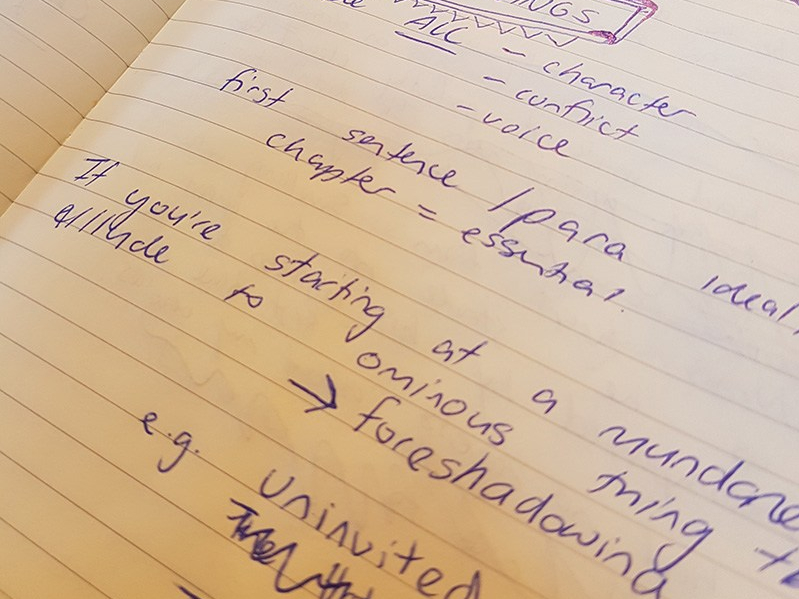
The takeaway is that the three key components of a great opening are:
Character
Conflict
Voice
Ideally, you establish all three as soon as possible, in the first few lines if you can, but within the first few pages at a stretch.
(Obviously, a hooky beginning can’t make a book good in and of itself; that’s what the rest of the novel is for!)
Sophie gave lots of examples of great hooky openings (and I’ve added some from books I love into the mix), all of which you also now get to enjoy as I ruminate my way through the mechanics of why they’re hooky. (Note that I haven’t read all of the books associated with these lines, but they are definitely all hooky!).
Character
A character-driven opening should lead us to ask an interesting question, make us feel for the character, and set up something about their everyday life.
Character-driven opening examples
Scarlet O’Hara was not beautiful, but men seldom realized it when caught by her charm as the Tarleton twins were.
—Gone with the Wind, Margaret Mitchell
I think the question here is: Who are the Tarleton twins and why is the apparently not-beautiful Scarlet charming them? (I have actually only seen the movie version of this, and my memory is pretty foggy, so this is a genuine question). Also, you have to feel for a heroine described as “not beautiful”. Pretty sure there’s a law.
Charlotte was one week short of seventeen when her life changed, falling into two halves like a shiny child’s ball: before and after.
—Potent Pleasures, Eloisa James
What changed your life, Charlotte? I must know!!!
I haven’t touched another person in three years.
—The Girl in 6e, Alessandra Torre
I HAVE SO MANY QUESTIONS!!!! Do you mean literally? Are you in some kind of terrible solitary confinement? Can I help you escape somehow?
Conflict
2/3 of the above examples also double as conflict-driven openings. The conflict component of a beginning instills foreboding, curiosity, or emotion, and hints at what the book’s larger conflict might be about.
Conflict-driven opening examples
“I’ll consider your debt paid in full if you get my wife with child.”
—Waking up with the Duke, Lorraine Heath
WHAAAAAAAT??? Who is he making this offer to? Why is he making this offer? Has his wife consented to this!!?? HOW IS THIS POSSIBLY GOING TO WORK OUT????
The day of the royal massacre started out like any other.
—Kill the Queen, Jennifer Estep
Well that’s incredibly ominous!
I’m pretty much fucked.
That’s my considered opinion.
Fucked.
Six days into what should be the greatest two months of my life, and it’s turned into a nightmare.
—The Martian, Andy Weir
This opening is also big on establishing character, but the main driving question is: What, exactly, has turned into a nightmare?
Our Dragon doesn’t eat the girls he takes, no matter what stories they tell outside our valley.
—Uprooted, Naomi Novik
This is from one of my favourite books, and it pulls me in every time! It evokes strong curiosity (who is this dragon, one immediately asks, and why is he taking girls?) There’s also something old-fashionedly fairytale-like even in just the first line, which very much captures the tone of the book.
Which brings us to…
Voice
This is the elusive spark of what-makes-one-author’s-style-distinct-from-every-other-author. It’s the adjective X in the sentence “Oh, this is such X writing”, where X might be clean / beautiful / funny / self-aware / intense etc.
Voice-driven opening examples
All of the above examples have strong voice, but here are even more:
It is a truth universally acknowledged, that a single man in possession of a good fortune, must be in want of a wife.
—Pride and Prejudice, Jane Austen
This opening has such a distinctive voice that we’ve been quoting it for over 200 years!
Everything starts somewhere, although many physicists disagree.
—Hogfather, Terry Pratchett
Ah, Terry Pratchett, my favourite fantasy author. Your dry, satirical voice is sorely missed.
Mr and Mrs Dursley of number four, Privet Drive, were proud to say that they were perfectly normal, thank you very much.
—Harry Potter and the Philosopher’s Stone, JK Rowling
I remember reading this line for the first time at the age of eleven and being simply unable to stop. I find this opening particularly interesting because Harry, our protagonist, is largely absent from the opening paragraphs, but the author’s voice is so engaging that it doesn’t matter. And the conflict of the book is hinted at in this very first line i.e. something very not normal is about to arrive on the Dursleys’ doorstep…
As part of the workshop, Sophie also got us to brainstorm openings based on various scenarios. I’m a slow thinker, so I haven’t yet managed to come up with any zingers like the ones above, but it’s filled me with determination to keep trying!
Fantasy is my first and truest love, but romance is a close second (a shocker, I know, if you’ve read my books 😉). So it was with great excitement that I headed off to Christchurch last weekend for my first-ever Romance Writers of New Zealand (RWNZ) conference.
Hagley Park, Christchurch
Years ago, when I was a university student, I spent a lot of time in Christchurch Airport, waiting for connecting flights as part of my journey home. I’m not sure this really counts as having visited the city. I can’t say I’ve now remedied this, since I spent last weekend largely within the four walls of the conference hotel.
However, I can say that the few bits of Christchurch I did see were both lovely and curiously English in aesthetic (and, coming from hilly Wellington, disconcertingly flat). The hotel abutted the large and picturesque Hagley Park, where the first signs of spring were juuust beginning, cherry blossoms and daffodils and a hint of warmth.
“The trees are coming into leaf. Like something almost being said—Philip Larkin
(I thought of this quote a lot during spring when I was overseas in Oxford, and Hagley Park had that same quality to it).
On Friday morning, I turned up to the registration desk and received my name badge and conference pack. A heart sticker adorned my badge, marking me as a first-time attendee.
The name badges were an absolute godsend. Some people say they remember faces but not names; I frequently remember neither. If only name badges were fashionable in more situations!
I was quite nervous that first morning, as the only person I knew wasn’t turning up until the Saturday. However, my nerves were completely unwarranted; everyone was extremely friendly (thanks to the aforementioned heart-sticker), and luckily we all had one ginormous thing in common that made it easy to start conversations!
“So, what do you write?” was the #1 conversation opener, for the very first time in my life.
I refined my answer to this over time and eventually settled on: “Think fantasy Downton Abbey.”
(I feel I must make an admission here; I’ve never actually watched Downton Abbey, but it’s a comparison that multiple reviewers have used and it’s a more comprehensible shorthand than “Er…secondary world early twentieth centuryish inspired fantasy-of-manners with fae and romance?”. Hopefully, when I do get around to watching it, I won’t discover that I’ve been merrily giving everyone an entirely false idea of what to expect!)
Onto the workshops!
There aren’t a lot of local professional development opportunities for genre writers in New Zealand. I’d heard through the grapevine that RWNZ conferences offer fantastic craft workshops that would be of benefit to any writer, not only those writing pure romance.
Well, I’m here to tell you that the grapevine was absolutely right.
My uncharacteristically organised note-taking.
Over the three days, I made fifty pages of notes. FIFTY. Beginnings, tension, characterisation through narration, and conflict were just some of the topics covered. I think I’ll write up a few of the sessions that particularly resonated with me in separate blog posts, but needless to say that by the end of the weekend, my brain was stuffed full of information and ideas.
Let no one tell you that writing romance is easy. These guys take their craft seriously. The whole conference was infused with a determination to learn, share ideas, and ultimately bring readers joy. But more than that, everyone there practically glowed with the love of writing. The enthusiasm was infectious and left me buzzing with renewed motivation to finish my work in progress.
Plus, as it turns out, romance authors and editors have great senses of humour.
One group’s ‘guesses’ at missing titles
If every duke featured in a regency romance actually existed, they’d outnumber the sheep in New Zealand*” —May Chen, Avon editor.
*Current NZ sheep numbers = 27.3 million, which by my calculation means every New Zealander gets ~5.6 dukes of their very own!
A bit of preface: I wrote most of this blog post aaaaages ago but never got around to finishing it. However, this week I discovered a new FB reader group called Romantic Fantasy Shelf, which has been set up by a bunch of indie authors and is focused on secondary-world Romantic Fantasy / Fantasy Romance / Reverse Harem fantasy and it (a) seemed right up my alley (go join if it’s up your alley too; they’re running a whole bunch of giveaways this month to celebrate the launch of the group) and (b) reminded me of this half-written blog post.
Now for the actual blog post:
Because I am me and like organising things into their Correct Places, I have spent a lot of time pondering genre nuances. And because my current project (the Stariel series) contains both fantasy and romance, this specific genre nuance (fantasy romance vs romantic fantasy) interests me particularly. Are they actually different subgenres or just different names for the same thing? Is there any real difference between the two subgenres in terms of reader expectations?
From a purely technical standpoint, fantasy romance is a subgenre of ROMANCE whereas romantic fantasy is a subgenre of FANTASY. In other words, you’d expect the dominant element to be the parent genre.
But if a book has both romance and fantasy, how do you tell which is the ‘dominant’ genre? And what if it’s an equal mixture of both?
I’ve been told that one simple way to figure out if you’re dealing with a book that has romance as its dominant genre is to ask yourself: ‘does the plot still pretty much work if I take out the romance?’ and if the answer is ‘no’, well, there you go; it’s a romance. It works for some books where the balance is clearly tipped more one way than the other.
For example, Tamora Pierce’s Alanna books still work if you take out the romance (though why would you do that!?) since the major plotline is the heroine training to be a knight.
By comparison, Robin McKinley’s Beauty doesn’t work if you take out the romance, since the main plot is about Beauty and the Beast’s relationship.
However, I have found this question of ‘does it still work if you take out the romance’ overly simplistic for a lot of books. If you take the romance out of C.L. Wilson’s Lord of the Fading Lands, you’ve still got fantasy worldbuilding and conflicts but you lose most of the character motivations.
Also, this cover is INSANE. Go, giant fire-breathing panther head, go!
Similarly with Jacqueline Carey’s Kushiel’s Dart. You can take out the romance and still have intricate politics, sexy courtesans, and war between nations, but, again, you lose major character motivations and some very big subplots.
For my own series, which falls into the Romantic Fantasy rather than Fantasy Romance camp, the answers to the question ‘does the plot work if you take out the romance?’ are:
Book 4: The King of Faerie – Well, it would be a totally different series by now without the romance elements so hard to say
Basically, it gets silly very quickly trying to figure out whether a book still works without half its ingredients. And, really, who wants half a cake? Er, book.
I thought another way to slice this might be to look at Amazon’s categories. Fantasy has a subcategory for “Romantic” and Romance has a subcategory for “Fantasy”. So what’s filed under each one?
A lot of the same books, as it turns out.
There are slightly more sexy man-chest covers under Romance>Fantasy and slightly more women-with-glowy-magic-hands covers under Fantasy>Romantic.
I think the main difference (if any) is that Fantasy Romance series are likely to feature a different couple in each book, whereas Romantic Fantasy series focus on the same characters over multiple books.
However, my main conclusion after looking at a bunch of books that mix romance and fantasy is that this quest has not helped my To-Be-Read list get any smaller.
It’s currently the heart of winter, which in Wellington means cold rain and wind. Lots of wind. The cats have become increasingly snuggly i.e. interested in sharing body warmth.
I feel the cold easily. The ambient temperature of cafes has thus become even more important to me than usual.
I do like the occasionally spectacular winter sunsets though.
For this reason, I’ve shifted my usual writing space from Mt Cook to Verve Cafe. Verve is located beneath an office/mall building in the CBD on Lambton Quay and gives the strong impression of being underground due to the complete lack of windows. I rather like the cosiness of this, but my friends have used words like “cave-like” to describe it.
Reasons to go there
Verve meets most of my key cafe criteria for writers, though the coffee quality is variable. There’s free WiFi, plenty of table space, comfy seats, many food choices. The staff seem relatively non-judgemental about my frequent presence as I desperately try to finish the last book in the Stariel Series.
Verve cafe on a quiet Sunday afternoon in July.
This is both a reason to go and not to go: The interesting playlists. I’m not sure who chooses them, but sometimes they exactly hit my preferences – one afternoon they played the entire soundtrack of Mamma Mia; another time, a list of nostalgic 90s pop hits. Other times, they choose a playlist diametrically opposed to my personal preferences, but YMMV (“I Whip My Hair Back and Forth” tests even my legendary ability to switch off my ears when I’m concentrating). Today is a good playlist day. As I write this, Tainted Love is playing in the background.
Reasons not to go there
If, you like to have some idea what the weather is doing before you go out in it, this is not the cafe for you, my friend. Sometimes I’ve been messaging people while inside Verve, suggesting we hang out, and they’re like: ARE YOU KIDDING? IT’S FREAKING BUCKETING DOWN AND GALE-FORCE WINDS OUTSIDE; I’M NOT LEAVING THE HOUSE.