Tag: writing craft

  • Productivity and Balance: Conference notes

    Productivity and Balance: Conference notes

    This is my write-up of the notes I took during a session on Productivity & Balance given by Nalini Singh at the Romance Writers of New Zealand 2021 conference in Wellington. As such, her actual words have been paraphrased and filtered through the chaos labyrinth of my own brain, so you should attribute all the useful bits to Nalini and any bits that don’t make sense to me.

    A hand supporting a stack of Nalini Singh books with black covers.
    Far from all the Nalini Singh books I own.

    I’ve been a fan of Nalini’s work ever since I picked up Angel’s Blood back when I was at uni in 2009, and every time I meet her, I try and utterly fail not to crazily fangirl at her. (She, however, is always kind and professional.)

    The overall thrust of Nalini’s talk was that you can’t be creative if you’re burned out, and that you need to build a work schedule that is sustainable over the long term. These were her tips, although she added the caveat that she is not the productivity police.

    I found this such an inspiring session, although also somewhat daunting thinking about the long term in so serious a fashion. There’s an imposter in my brain that whispers “who are you to think you deserve to take this seriously?”. Shush, imposter. Shush.

    Time Management

    You need to build a schedule that doesn’t exhaust you. You can’t keep up a relentless punishing schedule in the long term. It’s easy to build a ‘fantasy schedule’ that maximises productivity on paper but that will never work in reality, because there’s no room in it for anything unexpected or for all the non-writing tasks that surround writing, especially if you’re indie.

    Instead of a fantasy schedule, build in buffer time for unexpected things to happen. If nothing unexpected comes up, you’ll be ahead of schedule, but if your mum rings or the dog is sick or you need to spend two hours talking to Amazon customer service because your book page has mysteriously disappeared, you’ll already have the buffer in your schedule to cope with it.

    Write down your schedule for the day before you start but adjust it as you go on your writing days according to what comes up i.e. keep track of what you did, even if it’s not writing related. Then even if you were only able to write for 15 minutes, you’ll still be able to see it as an achievement within that day’s context.

    Don’t schedule every day / writing day you have (e.g. if you can only write on Mondays, don’t schedule writing every Monday between now and deadline). Build in unscheduled buffer days. Nalini doesn’t write on weekends.

    Set a knock-off time (especially applies if you write full-time). This creates ‘time scarcity’ for your brain and helps you to be motivated on getting things done. Otherwise it’s tempting to stretch tasks out to fill all the time there is.

    Set yourself up to start more easily tomorrow before you finish for the day e.g. leave a chapter slightly undone or leave yourself a note of what you were planning to do next. Put this ‘setting up for tomorrow’ time in your schedule for the end of the day!

    Relax consciously. Choose to watch TV or garden or chat on the internet; don’t default to e.g. scrolling through FB without making an active choice about how you are going to spend your leisure time.

    Focus

    Writing cues can help switch your brain into ‘writing mode’ e.g. a certain playlist you listen to when you start your writing session. Nalini uses a selection of rain sounds. I’ve also used this before and can recommend ‘rainy day cafe’ sounds and gaming music.

    Quality rather than quantity time. You can write a whole book in short bursts if that’s the only time you have and you focus. Each time you interrupt your brain it derails your focus for a much longer period of time than just the 30 seconds it took to check Twitter.

    Smartphones and social media are designed to be addictive and will give you squirrel brain.

    Batch email and social media – set aside a block of time(s) throughout your working day. Don’t check them consistently throughout the day.

    Create new norms and set boundaries – people don’t need to expect an immediate response. You can train them to understand your schedule e.g. not checking emails on weekends.

    Turn off notifications.

    Does the WiFi need to be on constantly? Maybe you could turn it off for 45 minutes while you do a writing session! (oh, it sounds so simple, but so hard!!!)

    Goals

    Set goals that are realistic and can be achieved through your own efforts. That way you get the satisfaction of achieving them, which is an emotional boost that gives you the motivation to aim for bigger goals. E.g. “I am going to apply for a Bookbub every month this year” (achievable) vs “I am going to get two Bookbubs this year” (not within your power to control)

    It is OK to take the longer road!

    Someone else’s speed has nothing to do with you.

    Multiple projects

    Nalini likes to do two different projects at a time: a main project and secondary project. The main project gets the bulk of the writing time, but being able to switch between two different things at a time helps her stay motivated and interested. Nalini recommends a secondary project that is either:

    • A completely different type of project
    • At a completely different stage in the process than the main project

    Her advice is to not commit publicly to the secondary project or put it in your release schedule – this should be your stress-free exploratory time without pressure. No one’s going to be mad when you tell people hooray there’s a surprise unexpected book! Nalini reckons it’s especially helpful if your main project is very written to market.

    Delegate

    You’re trying to run a one-person small publishing company. The work involved in this gets bigger the bigger you get. If you can delegate, delegate; only you can do the writing!

    Read

    You became a writer because you love reading. Make space for it.

    Look after your body

    You can only work from a laptop on the couch for so long before it catches up with you.

    I’m expanding out from Nalini’s session to include the tips from multiple people here. The whole panel of guests were asked how they looked after their wrists, and they all gave really intense, thoughtful answers, which goes to show this is a topic of great interest to writers! Things that they found helpful:

    • Dictation
    • Mechanical keyboard
    • Gaming chair
    • Standing desk
    • Compression gloves
    • Software that blanks their screen for e.g. 3 minutes every 1 hour and locks them out so they have no choice but to swear at it and then go stretch
    • Yoga
    • Scheduling excercise into the middle of the writing day
  • Writing hooky beginnings: workshop notes

    Writing hooky beginnings: workshop notes

    How do you hook a reader at the start of a book?

    Slow beginnings are something I feel I’m a bit prone to if I’m not careful (true story: The Lord of Stariel first draft originally had a whole ‘nother chapter before Chapter 1 that got cut during rewrites), so I was particularly interested in Sophie Jordan’s workshop on beginnings at the recent RWNZ conference I attended.

    (For the more general conference experience write-up, see previous blog post)

    Sophie Jordan writes romance, but the concepts she talked about are applicable across all fiction genres.

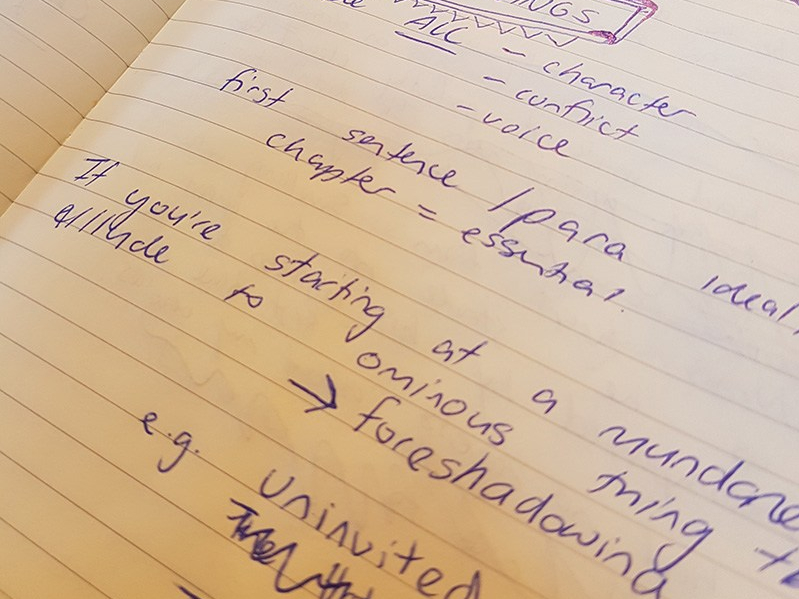
    The takeaway is that the three key components of a great opening are:

    1. Character
    2. Conflict
    3. Voice

    Ideally, you establish all three as soon as possible, in the first few lines if you can, but within the first few pages at a stretch.

    (Obviously, a hooky beginning can’t make a book good in and of itself; that’s what the rest of the novel is for!)

    Sophie gave lots of examples of great hooky openings (and I’ve added some from books I love into the mix), all of which you also now get to enjoy as I ruminate my way through the mechanics of why they’re hooky. (Note that I haven’t read all of the books associated with these lines, but they are definitely all hooky!).

    Character

    A character-driven opening should lead us to ask an interesting question, make us feel for the character, and set up something about their everyday life.

    Character-driven opening examples

    Scarlet O’Hara was not beautiful, but men seldom realized it when caught by her charm as the Tarleton twins were.

    Gone with the Wind, Margaret Mitchell

    I think the question here is: Who are the Tarleton twins and why is the apparently not-beautiful Scarlet charming them? (I have actually only seen the movie version of this, and my memory is pretty foggy, so this is a genuine question). Also, you have to feel for a heroine described as “not beautiful”. Pretty sure there’s a law.

    Charlotte was one week short of seventeen when her life changed, falling into two halves like a shiny child’s ball: before and after.

    Potent Pleasures, Eloisa James

    What changed your life, Charlotte? I must know!!!

    I haven’t touched another person in three years.

    The Girl in 6e, Alessandra Torre

    I HAVE SO MANY QUESTIONS!!!! Do you mean literally? Are you in some kind of terrible solitary confinement? Can I help you escape somehow?

    Conflict

    2/3 of the above examples also double as conflict-driven openings. The conflict component of a beginning instills foreboding, curiosity, or emotion, and hints at what the book’s larger conflict might be about.

    Conflict-driven opening examples

    “I’ll consider your debt paid in full if you get my wife with child.”

    Waking up with the Duke, Lorraine Heath

    WHAAAAAAAT??? Who is he making this offer to? Why is he making this offer? Has his wife consented to this!!?? HOW IS THIS POSSIBLY GOING TO WORK OUT????

    The day of the royal massacre started out like any other.

    Kill the Queen, Jennifer Estep

    Well that’s incredibly ominous!

    I’m pretty much fucked.

    That’s my considered opinion.

    Fucked.

    Six days into what should be the greatest two months of my life, and it’s turned into a nightmare.

    The Martian, Andy Weir

    This opening is also big on establishing character, but the main driving question is: What, exactly, has turned into a nightmare?

    Our Dragon doesn’t eat the girls he takes, no matter what stories they tell outside our valley.

    Uprooted, Naomi Novik

    This is from one of my favourite books, and it pulls me in every time! It evokes strong curiosity (who is this dragon, one immediately asks, and why is he taking girls?) There’s also something old-fashionedly fairytale-like even in just the first line, which very much captures the tone of the book.

    Which brings us to…

    Voice

    This is the elusive spark of what-makes-one-author’s-style-distinct-from-every-other-author. It’s the adjective X in the sentence “Oh, this is such X writing”, where X might be clean / beautiful / funny / self-aware / intense etc.

    Voice-driven opening examples

    All of the above examples have strong voice, but here are even more:

    It is a truth universally acknowledged, that a single man in possession of a good fortune, must be in want of a wife.

    Pride and Prejudice, Jane Austen

    This opening has such a distinctive voice that we’ve been quoting it for over 200 years!

    Everything starts somewhere, although many physicists disagree.

    Hogfather, Terry Pratchett

    Ah, Terry Pratchett, my favourite fantasy author. Your dry, satirical voice is sorely missed.

    Mr and Mrs Dursley of number four, Privet Drive, were proud to say that they were perfectly normal, thank you very much.

    Harry Potter and the Philosopher’s Stone, JK Rowling

    I remember reading this line for the first time at the age of eleven and being simply unable to stop. I find this opening particularly interesting because Harry, our protagonist, is largely absent from the opening paragraphs, but the author’s voice is so engaging that it doesn’t matter. And the conflict of the book is hinted at in this very first line i.e. something very not normal is about to arrive on the Dursleys’ doorstep…

    As part of the workshop, Sophie also got us to brainstorm openings based on various scenarios. I’m a slow thinker, so I haven’t yet managed to come up with any zingers like the ones above, but it’s filled me with determination to keep trying!

  • Hanging with other writers: the RWNZ 2019 Conference

    Hanging with other writers: the RWNZ 2019 Conference

    Fantasy is my first and truest love, but romance is a close second (a shocker, I know, if you’ve read my books 😉). So it was with great excitement that I headed off to Christchurch last weekend for my first-ever Romance Writers of New Zealand (RWNZ) conference.

    A footpath curving beneath bare-branched trees in Hagley Park. In the upper corner, pink blossoms are visible.
    Hagley Park, Christchurch

    Years ago, when I was a university student, I spent a lot of time in Christchurch Airport, waiting for connecting flights as part of my journey home. I’m not sure this really counts as having visited the city. I can’t say I’ve now remedied this, since I spent last weekend largely within the four walls of the conference hotel.

    However, I can say that the few bits of Christchurch I did see were both lovely and curiously English in aesthetic (and, coming from hilly Wellington, disconcertingly flat). The hotel abutted the large and picturesque Hagley Park, where the first signs of spring were juuust beginning, cherry blossoms and daffodils and a hint of warmth.

    “The trees are coming into leaf. Like something almost being said—Philip Larkin

    (I thought of this quote a lot during spring when I was overseas in Oxford, and Hagley Park had that same quality to it).

    On Friday morning, I turned up to the registration desk and received my name badge and conference pack. A heart sticker adorned my badge, marking me as a first-time attendee.

    The name badges were an absolute godsend. Some people say they remember faces but not names; I frequently remember neither. If only name badges were fashionable in more situations!

    I was quite nervous that first morning, as the only person I knew wasn’t turning up until the Saturday. However, my nerves were completely unwarranted; everyone was extremely friendly (thanks to the aforementioned heart-sticker), and luckily we all had one ginormous thing in common that made it easy to start conversations!

    “So, what do you write?” was the #1 conversation opener, for the very first time in my life.

    I refined my answer to this over time and eventually settled on: “Think fantasy Downton Abbey.”

    (I feel I must make an admission here; I’ve never actually watched Downton Abbey, but it’s a comparison that multiple reviewers have used and it’s a more comprehensible shorthand than “Er…secondary world early twentieth centuryish inspired fantasy-of-manners with fae and romance?”. Hopefully, when I do get around to watching it, I won’t discover that I’ve been merrily giving everyone an entirely false idea of what to expect!)

    Onto the workshops!

    There aren’t a lot of local professional development opportunities for genre writers in New Zealand. I’d heard through the grapevine that RWNZ conferences offer fantastic craft workshops that would be of benefit to any writer, not only those writing pure romance.

    Well, I’m here to tell you that the grapevine was absolutely right.

    The top part of a handwritten page of notes listing a Table of Contents.
    My uncharacteristically organised note-taking.

    Over the three days, I made fifty pages of notes. FIFTY. Beginnings, tension, characterisation through narration, and conflict were just some of the topics covered. I think I’ll write up a few of the sessions that particularly resonated with me in separate blog posts, but needless to say that by the end of the weekend, my brain was stuffed full of information and ideas.

    Let no one tell you that writing romance is easy. These guys take their craft seriously. The whole conference was infused with a determination to learn, share ideas, and ultimately bring readers joy. But more than that, everyone there practically glowed with the love of writing. The enthusiasm was infectious and left me buzzing with renewed motivation to finish my work in progress.

    Plus, as it turns out, romance authors and editors have great senses of humour.

    Book Title Quiz where all missing words have been replaced with the word
    One group’s ‘guesses’ at missing titles


    If every duke featured in a regency romance actually existed, they’d outnumber the sheep in New Zealand*” —May Chen, Avon editor.

    *Current NZ sheep numbers = 27.3 million, which by my calculation means every New Zealander gets ~5.6 dukes of their very own!

    Definitely planning to attend next year.