The short version: Two events, a drink that was ON FIRE, and a trophy!
The long version:
This weekend was the annual Romance Writers of New Zealand conference for 2021. This was my second RWNZ conference (I wrote about my first time here), and because of our closed borders, was a little smaller than usual and featured solely local talent rather than the usual line up of international guests. Turns out NZ’s local talent is pretty fabulous though, because it was a fantastic weekend.
In their infinite scheduling wisdom, the national science fiction and fantasy organisation announced very recently that they had decided to schedule their awards on the exact same night as the romance writers. Thus, I was faced with something of a dilemma. I would have liked to attend the RWNZ dinner and celebrate the winners there, but as I was a finalist for the national speculative fiction awards (the Sir Julius Vogel Awards), I decided I should probably go to that one.
I remember being in the crowd at my first-ever SJV ceremony, years before I had admitted to myself I wanted to be a writer. I thought that the pointy SJV trophies were one of the coolest trophy designs I’d seen, but I didn’t even daydream about winning one. After all, to do that would mean having a book published, and I wasn’t a writer.
The world turned.
I kept writing whilst not being a writer (I am sometimes not very bright). I moved nearly 20,000 km away from home. I wrote a book, a practice novel I never intended to let see the light of day. I called it The Lord of Stariel. I admitted to myself I might quite like writing.
I came home. I started publishing books.
Last year was the first time I made the finalist list for the awards, and the flock of pointy trophies sitting up by the podium took on a whole new meaning.
Awards don’t matter, really, you tell yourself. And they don’t; they’re not what keeps you typing when every word feels like a battle. They aren’t a measure of any objective Truth or Worth; every award has its own biases in who gets one and who doesn’t. You have not failed by not winning one. Making the finalist list is an achievement in itself. Plus, after the awards ceremony you get to drink and chat with cool people, which is fun regardless of the outcome.
I told myself the same things this year (and they are true things, I want to emphasise). But, oh, winning does feel good too!
This is a long-winded way of announcing that I won the Sir Julius Vogel Award for Best New Talent this year! I can’t remember what I said when I went up to receive it – it’s all a joyful blur – though friends assure me it was totally coherent and professional. I do remember the last line, though, which was me giddily bursting out with: “Yay, a pointy trophy!” as the presenter handed it to me.
Totally professional.
Here is the celebratory drink that I had afterwards, at a nearby pirate-themed bar. The bartender set my drink on fire (deliberately)!
My celebratory drink!
This was my last year of eligibility for this award, and coming so close on the heels of releasing my series finale was a special moment. Congratulations to all the finalists – there was some amazing talent represented on the lists – and to the winners on the night. Thank you so much to everyone who supported me on this journey.
So, The King of Faerie is the last book in my Stariel Quartet.
Well, only mostly, as it turns out.
Whilst The King of Faerie (Stariel #4) indeed wraps up Hetta and Wyn’s story and the main series arc, I found in writing it that there was another character whose story needed a bit more telling than I could fit within its pages. I’ve been hesitant to announce this because I initially thought this extra piece might be a bonus story or a novella that I could include as an add-on to Book 4 when it releases. However, having recently reached 30,000 words on this spin-off story without yet passing its midpoint, I think it’s time to admit that I am in fact writing another novel.
This is a very long-winded way of saying, yes, Marius Valstar is getting a book!
No blurb or cover yet, but I am delighted to announce the forthcoming existence of Of Plants & PrincesA Rake of His Own, which will sit chronologically after the events of The King of Faerie.
Update: A Rake Of His Own is now available to pre-order!
How do you reflect on a year where reality became stranger than fiction? Even from the small and personal perspective of my own indie career, the task is daunting.
To make some sort of sense of a year that felt a thousand years and simultaneously only five minutes long, I’ve split it into quarters.
I’ve also chosen to mainly focus on the small good things that happened to me. Quite aside from all the, er, general 2020-ness going on on a global scale, 2020 was my worst year ever in terms of words written, so it’s good to remind myself that wasn’t all it was.
1st Quarter: The Before Times
I publish a book
It’s slightly surprising to remember this because it feels so long ago. But in January 2020, The Court of Mortals released! Bringing my grand total of books published to THREE whole novels!
Fanart!
Also in January, the amazingly talented Chiara Schieder sent me this beautiful fanart of Wyn!!! I think I made a sound only audible to bats when it turned up unexpectedly in my inbox. One of my secret author dreams has been to inspire fanart, and I was tickled pink when it actually! happened!
I felt like a real author!!!
2nd Quarter: Lock-down
A fogbank lies over the weeks between March and May when New Zealand was in Levels 4 and 3 of our alert system. I remember driving out of Wellington on eerily quiet roads, the electronic highway signs flashing: “Stay calm; be kind. Level 4 at midnight.”
It felt like driving ahead of a storm, like a scene from a post-apocalyptic movie. I’d never felt dread with such physicality before; a persistent, painful tightness in my chest, the inability to focus, the bewildered surreality of a nation all tuning in each day for the 1pm press briefing.
Autumn is the loveliest time at my parents’ farm, I think, and the dissonance between the golden fields beneath crisp blue skies and the increasingly grim news headlines utterly did my head in. It was also our busiest time of year in my day job, and I was working remotely, but I didn’t get enough done, distracted and anxious as I was, and consequently worked a lot of overtime when we went back to Level 2.
3rd Quarter: Apparently a lot of stuff happened when I list it all out?
In this part of the year, New Zealand slowly returned to normal and the rest of the world largely didn’t. This dual reality continues even as I write this post. I’m grateful for my good fortune even as I worry for my friends and family overseas. Kia kaha, koutou.
Award nominations
I was a finalist in two categories for New Zealand’s SFF awards: The Prince of Secrets for Best Novel and my very own self for Best New Talent.
CoNZealand
End of July was CoNZealand! It wasn’t the Wellington-based conference we’d all hoped for, but there was an amazing array of online panels. I even spoke (incredibly nervously) on some!
Audiobooks!
In August, the first of the Stariel audiobooks was released by Podium Publishing, swiftly followed by #2 and #3. The audiobooks have brought me so so much joy. The narrator, Finty Williams, is AMAZING and has brought the stories to life. Whenever I feel my motivation for finishing the final book flagging, I remind myself that once it’s finished I’ll get to hear it in audiobook format!
Cake!
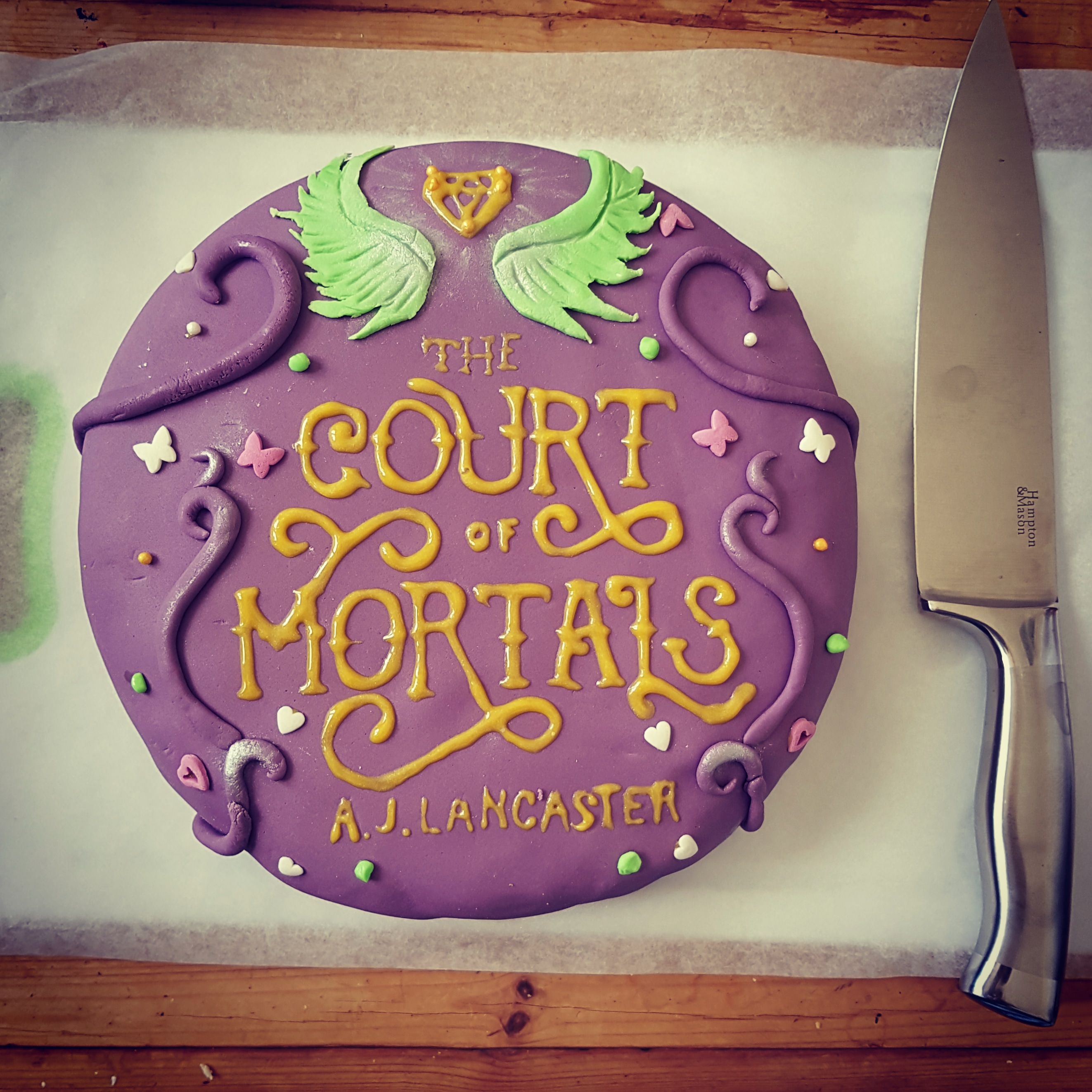
My sister made me two cakes this year, one when I launched The Court of Mortals and one when the audiobook of The Prince of Secrets released. Which now means I’m only one cake away from completing the set:
4th quarter: I finally start making writing progress again. Also, a review.
One of the last things that happened in 2020 was a glowing review for The Lord of Stariel on one of the biggest sites for romance reviews: Smart Bitches Trashy Books. I appreciate every single one of my reviews – they’re one of the most powerful ways readers can hear about my books. However, I generally avoid reading reviews for my own sanity. But this one gets a mention in my ‘list of positives amidst the sea of 2020’ not only because
(a) not gonna lie, it was hugely flattering to my ego but also
(b) it made my book sell like hotcakes,
which was extremely exciting to see when I checked my sales report.
2020 was my best year ever in terms of books sold and my worst year ever in terms of words written. I’m still feeling the effects of my lack of writing productivity; I’d originally intended to release Stariel #4 in January 2021, but that isn’t going to happen, due to the glacial progress I made for most of 2020.
I can’t even blame the pandemic. (Well, mostly; it probably didn’t help).
My writing paralysis dates from the Before Times in late 2019, after I finished The Court of Mortals. No matter how many hours I spent in front of the manuscript, endlessly writing, rewriting, arranging and rearranging scenes, the next book refused to work. My panic and self-loathing got fairly dire.
I may write a separate post about what helped kick me out of the spiral, but the good news is that my brain came back online in late 2020 and I’ve been making heaps of progress since. The King of Faerie will release in August, come hell or high water.
If you are a NZ library or bookstore, my books are available through Wheelers. You can also contact me directly and we’ll work something out.
Otherwise, this isn’t an exhaustive list, but here are some stores to get you started. You can also check out Bookshop.org or ask your local independent bookstore to order one for you!
I have sat on this cover for far too long, and since book 4 is finally, finally feeling like it’s taking a proper shape, I’ve decided to let it out of the bag.
Isn’t it just gorgeous? Once again, Jenny at Seedlings Design Studio has outdone herself. I love all my covers so much, but I think this one just might be my favourite.
LOOK HOW BEAUTIFUL THEY ARE TOGETHER!!!
I have also put The King of Faerie up for pre-order.
I have put it on the longest possible pre-order (a year) to make super sure I have enough time to finish it, but I am hoping to be able to bring the release date forward.
Here’s the blurb:
The fae are real, and Hetta Valstar is trying her best to marry one.
If Hetta and Wyn ever manage to marry, it will be the first union between Faerie and Mortal since the Iron Law was revoked.
The mortal Queen has given them her blessing—sort of. Now, Wyn needs permission from the fae High King. There’s an intensely personal reason why they need to tie the knot as soon as possible, and time is not on their side.
The clock is ticking. Except in Wyn’s home court, which is trapped under magical stasis. To break the spell will mean venturing into the deepest realms of Faerie, where even fae princes—and definitely human lords—fear to tread.
Unfortunately, the fae problems aren’t limited to Faerie.
Public tension is rising, and the reveal of Wyn’s true identity makes him and Hetta the centre of the storm. On top of this, Stariel’s magic is going haywire, and Hetta is struggling with her intensifying powers—and she might not be the only one affected.
The High King might be the only one who can help, since he’s responsible for the fae returning to the Mortal Realm in the first place.
In 2013, a friend dragged me along to the national NZ science fiction and fantasy convention, which that year was held in Wellington. My only knowledge of conventions up to that point came from American TV shows and movies; these had not prepared me for the NZ experience, which is much, much smaller (think around 100 people).
One of the items on the programme was called “NZ in 2020: Yes or No?”. I asked the friend what that meant, and they explained that it referred to deciding whether to put in a bid to hold a big international SFF convention in New Zealand in 2020. The big international convention was called Worldcon – the World Science Fiction Convention, and this was the first I’d ever heard of it.
“It’s not going to happen though,” the friend added, rolling their eyes. Even I, fandom-newbie, didn’t need to ask the reason for their doubt. Worldcon requires more volunteers than there were people in total at our national convention.
I didn’t go to that programme item. Obviously, other people did, and beavered away in the background, plotting.
In 2018, when New Zealand actually won the bid to host, the general reaction in my fannish circles was a kind of bewildered excitement – mixed with panic. Did the people making these sorts of decision know just how small NZ fandom is? Did they know that Wellington, the city it was going to be held in, doesn’t actually have a convention centre?
“We’re going to need, like, every SFF fan in New Zealand and all their dogs to mobilise to make this happen,” I said to a friend at the time, only half-joking. “Or it’s going to be a total omnishambles.”
(I will not swear to the actual word ‘omnishambles’ being used, but the meaning is true)
“Yes,” they said, “I’ve already volunteered,” and promptly roped me into volunteering too.
As well as panic, there was a dawning awareness of the opportunity this could mean. This would be an incredibly rare opportunity for New Zealand. New Zealand SFF writers could sell our books in the dealer’s hall at the convention – international fans would be looking for local books, right? Editors and agents the likes of which we never see on our shores would be there. We’d get a chance to hear and maybe meet big-name SFF authors. New Zealand’s national SFF awards (the Sir Julius Vogel Awards) would get a way way higher profile than normal.
(Though this is a low bar, since the Sir Julius Vogel Awards normally have a profile that is – being generous – limited to perhaps a few hundred people. They are not well-known awards within New Zealand. I’ve written a bit more about the awards here)
Of course, other things happened in 2020.
I think we all expected the convention to be cancelled, once the extent of the pandemic’s impact became clear. When the committee announced CoNZealand would instead be going virtual, my feelings were mixed. On the one hand, a virtual convention was better than no convention, but on the other, this wasn’t going to be the same as the convention being physically held in Wellington.
(Also, more selfishly, this meant I would still have to do the volunteer work I’d signed up for.)
However, I’d already paid my membership fee, so what did I have to lose?
So, basically, this is a very long preamble to the main post of:
How did my Worldcon 2020 experience go?
I have now emerged out the other side of my very first Worldcon. It was, as I suspect many things are, a mixed bag (the Hugo ceremony being a notable lowlight), and I still feel a bit deer-blinking-in-the-headlights about it all.
However, in this post I’m choosing to focus on the personal highlights of my first Worldcon experience, for posterity:
The 2020 Sir Julius Vogel Awards
This was one of only two in-person Worldcon events. The ceremony was filmed four days before the recording aired as part of the wider CoNZealand programme, and we were all sworn to secrecy about the results.
The physical ceremony was a great night out. I was nominated for Best New Talent and Best Novel, though I wasn’t expecting to win either (and lo; I did not) – but being a finalist and getting to celebrate nerdy NZ SFF creations and my friends’ achievements on the night was great fun. There was also an open bar.
You can check out the full list of finalists and the winners here (Congratulations all!!! You’re a fabulous lot, and I was honoured to share a ballot and a lot of alcohol with you.). A particular shout-out to Melanie Harding-Shaw, who, most deservedly, won the award for Services to Science Fiction, Fantasy, and Horror.
Being on a panel(s!)
Prior to this, I’d been on a grand total of (1) panel at one of NZ’s aforementioned very small national conventions. I got the opportunity to be on (2) panels at Worldcon, and I was so nervous in the lead up to them that I just about had kittens. I’m not a real* author; I can’t be on real panels! EVERYONE WILL SEE THROUGH MY FACADE.
*My brain’s definition of ‘real’ in this context is entirely irrational and appears to be “real author = any author who is not me”.
These were my panels:
Imagining Fae in Aotearoa and elsewhere – with Hester J. Rook, Rem Wigmore, Jodi McAlister, and Peter Hassall.
Fairy Tale Contract Law – with Sascha Stronach and Kathleen Jennings
The first panel was made, er, interesting by the dawning realisation during the panel that one of my fellow panellists believed in fairies (and aliens, as it turned out). Gosh.
On the plus side, this panel is also the reason I discovered Jodi McAlister’s compulsively readable Valentineseries (evil fairies in small-town Australia!), which I have now read all of. I can also recommend Rem’s off-beat Wellington urban fantasy The Wind City, which I read a number of years ago.
I was a lot less nervous for my second panel on fairy contract law. It was pure fun, and has made me want to write an entire anthology of things that could go wrong with fairies bargaining for firstborn children.
(What if the fairy only partially fulfils the bargain; does that mean you have to organise some sort of shared-custody arrangement? What if you marry the fairy and your firstborn is thus their firstborn also? What if fairies aren’t very good at telling human ages, and collect the wrong child?)
I have not yet read Kathleen’s just-released novella Flyaway, but it sounds extremely pertinent to my interests! Sascha’s urban fantasy The Dawnhounds was the book that took out the 2020 SJV for Best Novel, and I can recommend it for truly lovely prose and vivid SE Asian-inspired mushroom worldbuilding.
In addition to my panels, I also did my very first reading! Which mostly made me appreciate just what a good job the narrator of my audiobook has done. My own rendition seemed more likely to convince people to avoid the book at all costs than anything else; Finty’s one makes even me want to keep listening to find out what happens!
The WSFS Business Meeting
I’m not joking; this really was a highlight.
Long story short: WsfSfkslj (can never remember the proper acronym: everyone just says “whiss-fiss”) is the official organisation that runs Worldcon, and its constitution says it has to have an in-person meeting at the con or it will cease to exist. There’s no allowance for proxy voting or virtual attendance apparently.
Obviously, this presented something of a problem, since the only people who would be able to attend an in-person business meeting in Wellington were, well, New Zealanders, which seemed a bit unfair to everyone else.
So what did we do? We agreed, unanimously, to do nothing! It was very fun, and went roughly like this:
Chair (glares at the assorted people they’ve bullied into attending in order to achieve quorum, including Yours Truly): Please consider, that when I ask for objections, it is not necessary to say anything.
Us: Are you going to use the gavel? Where did that gavel even come from?
Chair (looks down at gavel on the desk in front of them in surprise): No idea. Maybe Norman brought it? And yes, yes, I am going to use it. OK, here we go: Motion to defer [Item X] until next year. Any objections? (Chair glares at Us)
You can watch the entire event in all its administrative nonsense (minus the intermission) here.
Attending panels
One of the great things about the virtualness of CoNZealand was that the panels were recorded, which meant I was able to watch more than I could’ve otherwise (though it’s a pity they weren’t available for longer, as they were taken down before I watched all I wanted to). There were such a lot of panels, on an astonishing variety of stuff! Here’s just a tiny snapshot:
Infinite Entangled Futures: Indigenous Voices in Conversation
Terrain of the Heart: Landscapes that Influence Story
Constructed Language: From Elvish to Esperanto to Dothraki to Belter
These Old Shades: If Georgette Heyer Wrote a Ghost Story
Also, have a random quote from the Constructed Languages panel that made me laugh, mainly because coming up with fantasy names for stuff is something I really struggle with:
“There’s two poles, shall we say, of how to [include a made-up language in fiction]. One is, you write it down so that hopefully the maximum number of readers can look at it and will pronounce it the way that you intended it to be pronounced.
And then on the other pole there is this kind of – I don’t want to go so far as to call it ‘woo’ – but the idea that you stylise the words to evoke some sort of sense in the reader, so that they just look at it and think ‘Wow, that word really looks like something. I don’t know how it’s pronounced, but it sure looks like something!’” – David Peterson
The volunteers
I personally know only a tiny fraction of all those whose volunteering helped make Worldcon happen, but that tiny fraction was mighty! A particular shout-out to my fellow Wellingtonian writer Darusha Wehm, who good-naturedly nudged me into volunteering in the first place. Darusha and I have fairly different tastes in fiction, but they are an excellent writer (and person) despite their wrongheaded insistence that robots are better than fairies, and you can check out their books here.
Concluding thoughts
So, was CoNZealand as good as the in-person convention I was originally looking forward to? Well, it’s hard to be certain, since that event exists only in the imagination, but I think probably not. Was it a perfect event? Also no. But am I glad I went? Yes, very much so.
This is a special year for New Zealand’s speculative fiction awards, the Sir Julius Vogel (SJV) awards.
Never heard of the SJVs or Sir Julius Vogel? Fear not, I’m here to meet all your long-winded explanation needs!
I only became aware of the SJVs when I started getting into New Zealand’s publishing / writing scene, despite being a big fantasy reader for many years before that. Judging from the number of blank looks I get when I mention the awards to other New Zealanders who are readers but not writers, I don’t think this is at all an atypical experience.
OK, so what is an SJV award?
It’s a metallic, pointy trophy that looks like this:
The awards recognise achievements in NZ science fiction, fantasy, or horror. There are lots of categories, from short stories to best novel to services to fandom.
Why are they called Sir Julius Vogel Awards?
The awards are named after Sir Julius Vogel, an early prime minister of New Zealand. He is credited with writing New Zealand’s first speculative fiction novel Anno Domini 2000, or, Woman’s Destiny in 1889.
I haven’t read it for myself, but reviews suggest it’s unfortunately not a very good book. On the brighter side, the same reviews do think it predicted aspects of the future accurately, so that’s sort of cool?
Er…moving on.
What’s eligible for an award?
The main eligibility criteria is that the work is by a NZ citizen or resident. Oh, and that it’s published in the year before the award is given – so works published in 2019 are eligible for the 2020 awards.
(psst, THE PRINCE OF SECRETS was published in 2019).
The awards process is:
Anyone, anywhere in the world, can nominate works using this form.
The eligible works that receive the most nominations make it onto the shortlist of up to 5 finalists for each category.
Members of SFFANZ (Science Fiction and Fantasy Association of New Zealand) and/or the national science fiction convention for that year vote to decide the winner for each category.
Now, before I get to why this year is special, I have to talk about NZ’s national science fiction conventions.
NZ’s national science fiction conventions (natcons)
So, first off, we have national science fiction conventions. Every year. This may or may not be news to you, but it was something else I learnt only a few years ago. This is probably because NZ’s national conventions are pretty small (~150 people) and fan-run (i.e. don’t have a huge advertising budget).
Once you find them they are, however, very fun. The first one I went to was in 2013, which was…seven years ago. Huh. Time flies, eh?
To make the national conventions trickier to keep track of, their name changes every year depending on which city is hosting. For example, 2019’s national convention was Geysercon, held in Rotorua, known for, you guessed it, thermal mud.
But this year, 2020, New Zealand isn’t just having a normal national convention. We’re having an international one!
The World Science Fiction Convention 2020: CoNZealand
For the very first time, New Zealand is hosting the World Science Fiction Convention. This is an international, entirely volunteer-run convention that moves countries each year, and is where the Hugos are awarded.
Worldcon is going to double as New Zealand’s national science fiction convention this year.
Which means that all the Worldcon attendees will also get to vote for the SJVs this year.
Which basically means an order of magnitude more people than usual will looking at the finalists and voting.
Which means that making the shortlist this year would be really, really awesome. And it all depends on getting enough nominations.
This is where you come in. Please consider nominating my or any other NZ SFF works. The nomination web form is HERE.
My eligible works
The awards I am eligible for this year are:
Best Novel
The Prince of Secrets by AJ Lancaster
Publisher: Camberion Press (that’s just the name for my own indie imprint)
Contact details – aj@ajlancaster.com
Best New Talent
I’m technically eligible for this, since I’m still within my first four years as a professional.
The amazingly organised Melanie Harding-Shaw has also put together an unofficial spreadsheet of eligible works, and I recommend checking it out if you’re interested in what New Zealanders speculative fiction creatives have been putting out in the last year.
Self-publishing effectively involves starting your own small business – on top of the actual writing and, in many people’s cases, including my own – on top of the full-time day job and general detritus of life administration.
Piecing together stolen moments – from lunch hours and evenings and weekends, while waiting at bus stops and seated on planes – does strange things to one’s sense of time.
But it has only been a year since I published The Lord of Stariel. Wow.
The happenings of a year are too much to fit in one blog post, so here is a random sampling of eight highlights (in no particular order).
#1 Seriously awesome covers
I could not be happier with the covers for my books, made by Jenny Zemanek at Seedlings Design Studio. Here are the three so far revealed (you’ll have to wait for Book 4’s cover, but it is every bit as pretty).
So pretty!
#2 Book Launch Party
I launched The Lord of Stariel in my living room last November because I wanted it to be as non-stressful and fun as possible. I made cake; my sister decorated it. I wore a T-shirt with my book cover on. I stacked a pile of books nonchalantly in the corner and signed them upon request.
Book cake!
I highly recommend this approach to book launches and am in fact planning the exact same sort of event for the launch of Book 3 (I didn’t have an official party for Book 2 because it released so soon after Book 1).
#3 Hard copies on my shelf
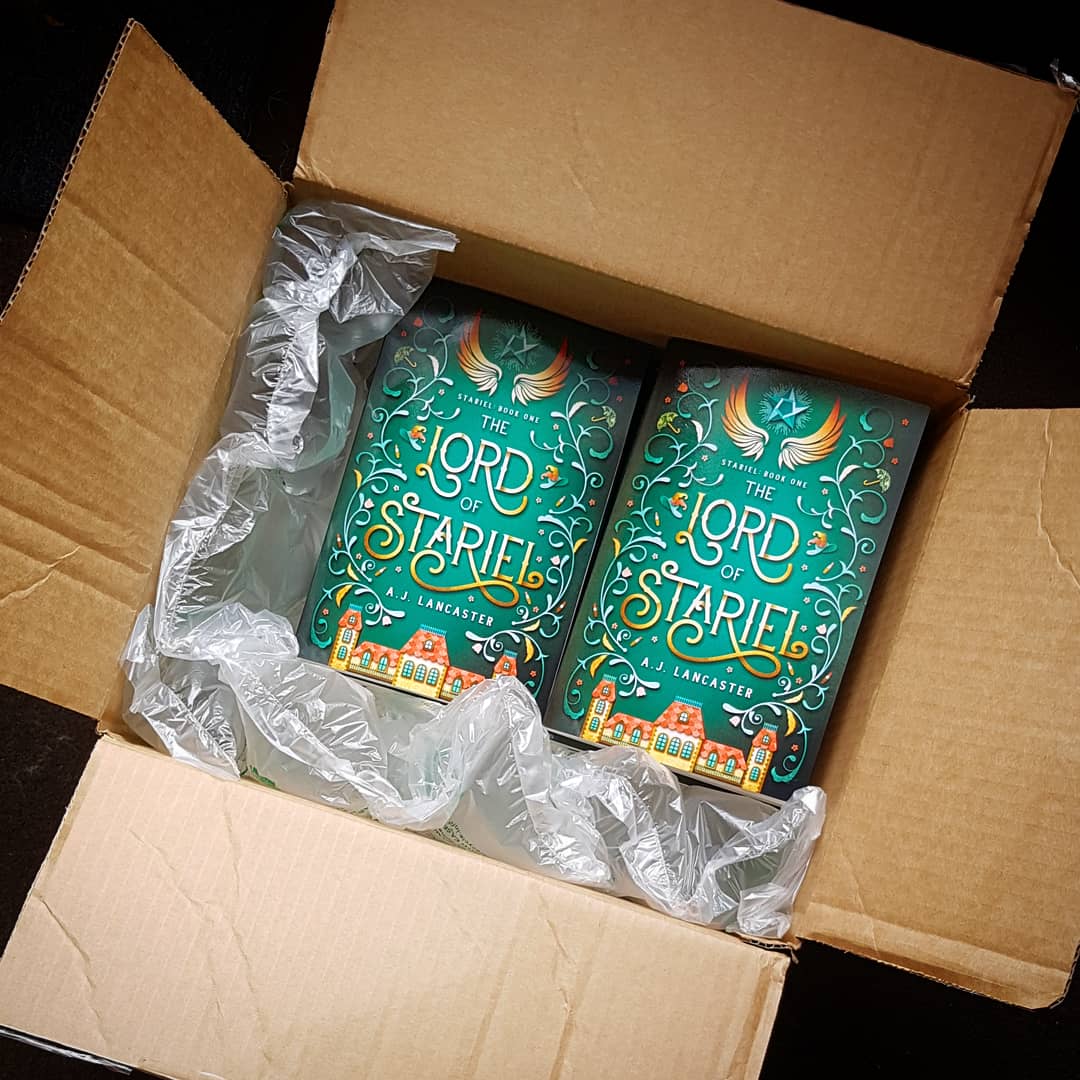
I think every author imagines the moment when they will hold a physical copy of their finished book in their hands. When my box of advanced copies arrived (for the book launch!), I let out a noise audible only to bats.
#4 Publishing Book 2
Writing and publishing one book could be written off as a fluke; publishing my second book The Prince of Secrets made my dreams of a writing career feel less like a dream and more like something I could build, one brick (book) at a time.
#5 Books in libraries!
Because I am self-published, I wasn’t sure whether my books would make it into libraries. But they have! Mostly to NZ libraries, but also to some in the US! I even found one on the shelf in the temporary Wellington central library (temporary due to the closure of the main library because of earthquake risk).
(Do feel free to request your library get a copy of The Lord of Stariel or The Prince of Secrets…)
#6 Meeting other local writers
Who knew there were so many fantasy writers in Wellington!
A big shout out to Melanie Harding-Shaw, who has this year been determinedly reaching out and organising Wellington speculative fiction writers into regular meet-ups, a process that bears no small resemblance to herding cats.
Earlier this year I also attended the Romance Writers of New Zealand conference in Christchurch (and wrote about it here), which exceeded expectations in terms of both fun and learning. I have yet to make it along to a Wellington chapter meeting due to scheduling conflicts, but they keep inviting me, so I hope to make it along to one in 2020!
#7 SPFBO5 (Self-Published Fantasy Blog-Off 5)
This is a competition orchestrated by author Mark Lawrence. It involves 10 book bloggers working their way through 300 self-published fantasy titles to choose the winner.
The competition is still underway, and The Lord of Stariel remains in the running as of this blog post, having been picked as a semi-finalist by the blog it was assigned to. I’m thrilled about that, but that’s not actually the highlight I’m celebrating here. No, what I want to celebrate is that I fronted up to the start line and entered my book into the competition at all!
I am my own worst enemy, and tend to not even enter things because I’ve already decided I’m unworthy. You can’t fail if you don’t sign up, right? This year I’ve been making a concerted effort to stop thinking like that, and to start thinking more like, well, this:
“Success is not final, failure is not fatal: it is the courage to continue that counts”—Winston Churchill
“It is impossible to live without failing at something, unless you live so cautiously that you might as well not have lived at all – in which case, you fail by default.”—JK Rowling
“The master has failed more times than the beginner has ever tried.”—Stephen McCranie
“Failures, repeated failures, are finger posts on the road to achievement. One fails forward toward success.” —C. S. Lewis
I like inspirational quotes, but they can also make it sound like a very glib process, when the reality of putting myself forward and risking failure has been extremely difficult—but also rewarding, I think. The more you shove at the edges of your comfort zone, the bigger it gets.
(As well as being a small milestone in my ongoing journey of Trying To Hide Myself Under Rocks Less, being part of SPFBO has also turned out to be quite fun. There’s a feeling of community to it and heaps of good indie fantasy books to be found by browsing the list of SPFBO books. I shall have to do another post on ones I’ve read and enjoyed so far!)
#8 Readers
Last November, the only way I could make myself press that big ‘publish’ button was to pretend that no one would actually read my book.
This, delightfully, has turned out to be not true. The first time a reader got in touch to say how much they liked my book, I had to take several hours to compose myself sufficiently to be able to respond with some degree of professionalism rather than a string of incoherent exclamation marks.
So thank you, readers, for buying my book, for leaving reviews, for sending me emails, for making and liking posts, and for tweeting tweets. You have been the most wonderful part of this indie publishing gig.
Alritey folks – after much shilly-shallying, I can finally reveal the cover and blurb for Stariel #3 The Court of Mortals.
Once again, the fabulous Jenny Zemanek at Seedlings Design Studio has outdone herself. I love it so, so much! Tiny crowns! Tiny envelopes! Majestic palace!
Marrying your fae prince shouldn’t be this hard.
Hetta’s family now knows Wyn’s true identity, but that doesn’t mean they approve of their relationship. Princes are all very well – but Wyn’s not human, for all he’s spent ten years pretending to be.
With gossip spreading like wildfire, Hetta and Wyn receive a royal summons. The Queen of Prydein has heard the rumours of fae intruders, and she’s not letting Wyn go until she’s satisfied he and his people aren’t a threat. Convincing her would be a lot easier if someone wasn’t trying to blacken Wyn’s name – and if his sister wasn’t trying to kill him.
For mortal politics aren’t the only problem the pair have to face. The Court of Ten Thousand Spires is still without a ruler, and the only way out may be for Wyn to assume the throne himself – meaning he and Hetta can never be together.
Releases 18 January 2020. Pre-order your copy now!