Author: AJLancaster

  • Hanging with other writers: the RWNZ 2019 Conference

    Hanging with other writers: the RWNZ 2019 Conference

    Fantasy is my first and truest love, but romance is a close second (a shocker, I know, if you’ve read my books 😉). So it was with great excitement that I headed off to Christchurch last weekend for my first-ever Romance Writers of New Zealand (RWNZ) conference.

    A footpath curving beneath bare-branched trees in Hagley Park. In the upper corner, pink blossoms are visible.
    Hagley Park, Christchurch

    Years ago, when I was a university student, I spent a lot of time in Christchurch Airport, waiting for connecting flights as part of my journey home. I’m not sure this really counts as having visited the city. I can’t say I’ve now remedied this, since I spent last weekend largely within the four walls of the conference hotel.

    However, I can say that the few bits of Christchurch I did see were both lovely and curiously English in aesthetic (and, coming from hilly Wellington, disconcertingly flat). The hotel abutted the large and picturesque Hagley Park, where the first signs of spring were juuust beginning, cherry blossoms and daffodils and a hint of warmth.

    “The trees are coming into leaf. Like something almost being said—Philip Larkin

    (I thought of this quote a lot during spring when I was overseas in Oxford, and Hagley Park had that same quality to it).

    On Friday morning, I turned up to the registration desk and received my name badge and conference pack. A heart sticker adorned my badge, marking me as a first-time attendee.

    The name badges were an absolute godsend. Some people say they remember faces but not names; I frequently remember neither. If only name badges were fashionable in more situations!

    I was quite nervous that first morning, as the only person I knew wasn’t turning up until the Saturday. However, my nerves were completely unwarranted; everyone was extremely friendly (thanks to the aforementioned heart-sticker), and luckily we all had one ginormous thing in common that made it easy to start conversations!

    “So, what do you write?” was the #1 conversation opener, for the very first time in my life.

    I refined my answer to this over time and eventually settled on: “Think fantasy Downton Abbey.”

    (I feel I must make an admission here; I’ve never actually watched Downton Abbey, but it’s a comparison that multiple reviewers have used and it’s a more comprehensible shorthand than “Er…secondary world early twentieth centuryish inspired fantasy-of-manners with fae and romance?”. Hopefully, when I do get around to watching it, I won’t discover that I’ve been merrily giving everyone an entirely false idea of what to expect!)

    Onto the workshops!

    There aren’t a lot of local professional development opportunities for genre writers in New Zealand. I’d heard through the grapevine that RWNZ conferences offer fantastic craft workshops that would be of benefit to any writer, not only those writing pure romance.

    Well, I’m here to tell you that the grapevine was absolutely right.

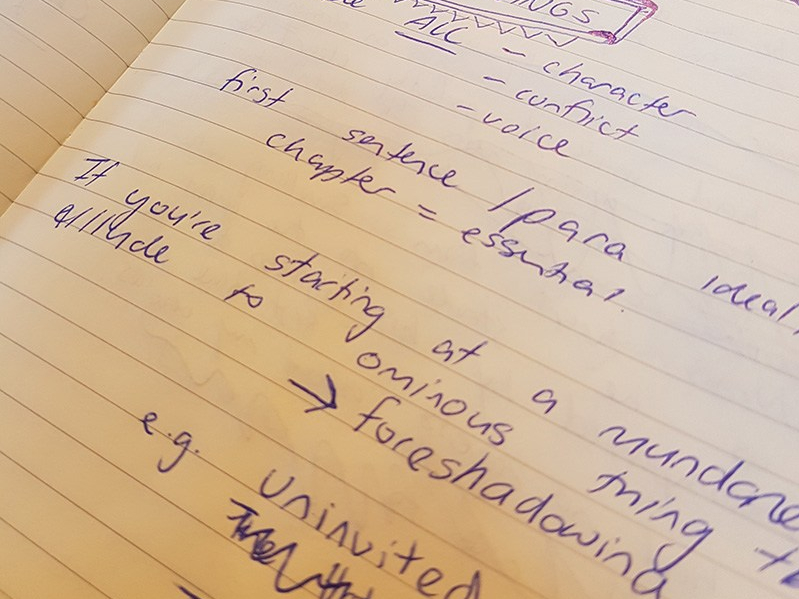
    The top part of a handwritten page of notes listing a Table of Contents.
    My uncharacteristically organised note-taking.

    Over the three days, I made fifty pages of notes. FIFTY. Beginnings, tension, characterisation through narration, and conflict were just some of the topics covered. I think I’ll write up a few of the sessions that particularly resonated with me in separate blog posts, but needless to say that by the end of the weekend, my brain was stuffed full of information and ideas.

    Let no one tell you that writing romance is easy. These guys take their craft seriously. The whole conference was infused with a determination to learn, share ideas, and ultimately bring readers joy. But more than that, everyone there practically glowed with the love of writing. The enthusiasm was infectious and left me buzzing with renewed motivation to finish my work in progress.

    Plus, as it turns out, romance authors and editors have great senses of humour.

    Book Title Quiz where all missing words have been replaced with the word
    One group’s ‘guesses’ at missing titles


    If every duke featured in a regency romance actually existed, they’d outnumber the sheep in New Zealand*” —May Chen, Avon editor.

    *Current NZ sheep numbers = 27.3 million, which by my calculation means every New Zealander gets ~5.6 dukes of their very own!

    Definitely planning to attend next year.

  • Fantasy Romance vs Romantic Fantasy: Is there a difference between these subgenres?

    Fantasy Romance vs Romantic Fantasy: Is there a difference between these subgenres?

    A bit of preface: I wrote most of this blog post aaaaages ago but never got around to finishing it. However, this week I discovered a new FB reader group called Romantic Fantasy Shelf, which has been set up by a bunch of indie authors and is focused on secondary-world Romantic Fantasy / Fantasy Romance / Reverse Harem fantasy and it (a) seemed right up my alley (go join if it’s up your alley too; they’re running a whole bunch of giveaways this month to celebrate the launch of the group) and (b) reminded me of this half-written blog post.

    romantic fantasy launch event

    Now for the actual blog post:

    Because I am me and like organising things into their Correct Places, I have spent a lot of time pondering genre nuances. And because my current project (the Stariel series) contains both fantasy and romance, this specific genre nuance (fantasy romance vs romantic fantasy) interests me particularly. Are they actually different subgenres or just different names for the same thing? Is there any real difference between the two subgenres in terms of reader expectations?

    From a purely technical standpoint, fantasy romance is a subgenre of ROMANCE whereas romantic fantasy is a subgenre of FANTASY. In other words, you’d expect the dominant element to be the parent genre.

    But if a book has both romance and fantasy, how do you tell which is the ‘dominant’ genre? And what if it’s an equal mixture of both?

    I’ve been told that one simple way to figure out if you’re dealing with a book that has romance as its dominant genre is to ask yourself: ‘does the plot still pretty much work if I take out the romance?’ and if the answer is ‘no’, well, there you go; it’s a romance. It works for some books where the balance is clearly tipped more one way than the other.

    For example, Tamora Pierce’s Alanna books still work if you take out the romance (though why would you do that!?) since the major plotline is the heroine training to be a knight.

    Tamora Pierce Song of the Lioness Quartet

    By comparison, Robin McKinley’s Beauty doesn’t work if you take out the romance, since the main plot is about Beauty and the Beast’s relationship.

    Beauty by Robin McKinley

    However, I have found this question of ‘does it still work if you take out the romance’ overly simplistic for a lot of books. If you take the romance out of C.L. Wilson’s  Lord of the Fading Lands, you’ve still got fantasy worldbuilding and conflicts but you lose most of the character motivations.

    Lord of the Fading Lands
    Also, this cover is INSANE. Go, giant fire-breathing panther head, go!

    Similarly with Jacqueline Carey’s Kushiel’s Dart. You can take out the romance and still have intricate politics, sexy courtesans, and war between nations, but, again, you lose major character motivations and some very big subplots.

    Jacqueline Carey Kushiel's Dart

    For my own series, which falls into the Romantic Fantasy rather than Fantasy Romance camp, the answers to the question ‘does the plot work if you take out the romance?’ are:

    • Book 1: The Lord of Stariel – Mostly yes
    • Book 2: The Prince of Secrets – Mostly no
    • Book 3: The Court of Mortals – Sort of?
    • Book 4: The King of Faerie – Well, it would be a totally different series by now without the romance elements so hard to say

    Basically, it gets silly very quickly trying to figure out whether a book still works without half its ingredients. And, really, who wants half a cake? Er, book.

    I thought another way to slice this might be to look at Amazon’s categories. Fantasy has a subcategory for “Romantic” and Romance has a subcategory for “Fantasy”. So what’s filed under each one?

    A lot of the same books, as it turns out.

    There are slightly more sexy man-chest covers under Romance>Fantasy and slightly more women-with-glowy-magic-hands covers under Fantasy>Romantic.

    I think the main difference (if any) is that Fantasy Romance series are likely to feature a different couple in each book, whereas Romantic Fantasy series focus on the same characters over multiple books.

    However, my main conclusion after looking at a bunch of books that mix romance and fantasy is that this quest has not helped my To-Be-Read list get any smaller.

  • Typesetting Madness

    Typesetting Madness

    This month I have been typesetting up a storm to get paperback copies of The Lord of Stariel ready for release in November.

    Typesetting is the process of formatting a book, so called because back in the day it involved physically setting type. I’ve done this the old-fashioned way exactly once in my life, as part of a training course, and whilst fun it definitely isn’t something you’d want to do for an entire book (it took me about 20 minutes to set my one allocated line of type!).

    font-705667_1280
    Many teeny blocks of lead

    Nowadays, typesetting means electronically laying out a book for print (and laying out the e-book, but that’s a whole ‘nother kettle of fish). I happen to really, really love print typesetting, because I am exactly the kind of person who will agonise over an extra half-millimetre of margin and spend hours weighing up the pros and cons of different fonts.

    If you are not this kind of person, there are some automated solutions. I use one of these (a program called Vellum) for formatting e-books. To my mind, there’s no point agonising over e-book formatting because the appearance of an e-book changes across platforms anyway. You have to let go of the illusion of control.

    You know what you can control to your heart’s content, though? Print books! For typesetting print books, I use Adobe InDesign, which is a control freak’s dream. This is both a great and terrible power. On the bright side, there will be no auto-formatting doing things you didn’t tell it to do (I’m looking at you, Microsoft Word), but on the down side, there will be no auto-formatting to save you. All faults will be entirely your own.

    Microsoft Word formatting
    Truth.

    You can’t truly judge your typesetting until you see a physical proof copy, but printing out pages and cutting them to the correct page size is a useful proxy. Hence my living room has been looking like a bookish murder scene recently, full of disembodied pages:

    1_tLoS_IG_typesetting
    Many iterations of pages with slightly different margins, leading, or font sizes. May appear identical to the untrained or less obsessive eye.

    Once you’ve typeset your book, you then know how many pages it will be – which means you can work out the spine width! And from the spine width comes the BEAUTIFUL FULL COVER SPREAD thanks to my designer:

    The Lord of Stariel full cover spread
    What the paperback version of my book will look like when ironed (DO NOT IRON BOOKS!)

    The last thing to decide on for a print book is the cover finish. As an indie publisher, I have two choices: matte or gloss finish (other cool combo options like metallic foiling and spot gloss etc aren’t available with the print-on-demand (POD) providers I’m using. I’ll do a separate blog about that, but basically POD means someone can order 1 copy of my book from a retailer and behind the scenes the printer will print and ship 1 copy directly to the customer.)

    It’s quite hard to show the difference in a photograph, but gloss finish is, er, glossy, and makes colours seem richer. Matte is, er, not glossy, and it feels smoother in the hand but can ‘flatten’ darker colours.

    1_tLoS_IG_paperback_proofs_in_different_finishes
    Proof copies! BE STILL MY BEATING HEART. Matte finish is on the left; gloss finish on the right. (You can’t tell from this photo at all, but they actually do look extremely different in real life.)

    Next step: Checking the proof copies! (It would be impossible to overstate how overwhelmingly excited I am to be able to hold ACTUAL PHYSICAL COPIES OF MY BOOK.)

  • Less than one month to go…

    Less than one month to go…

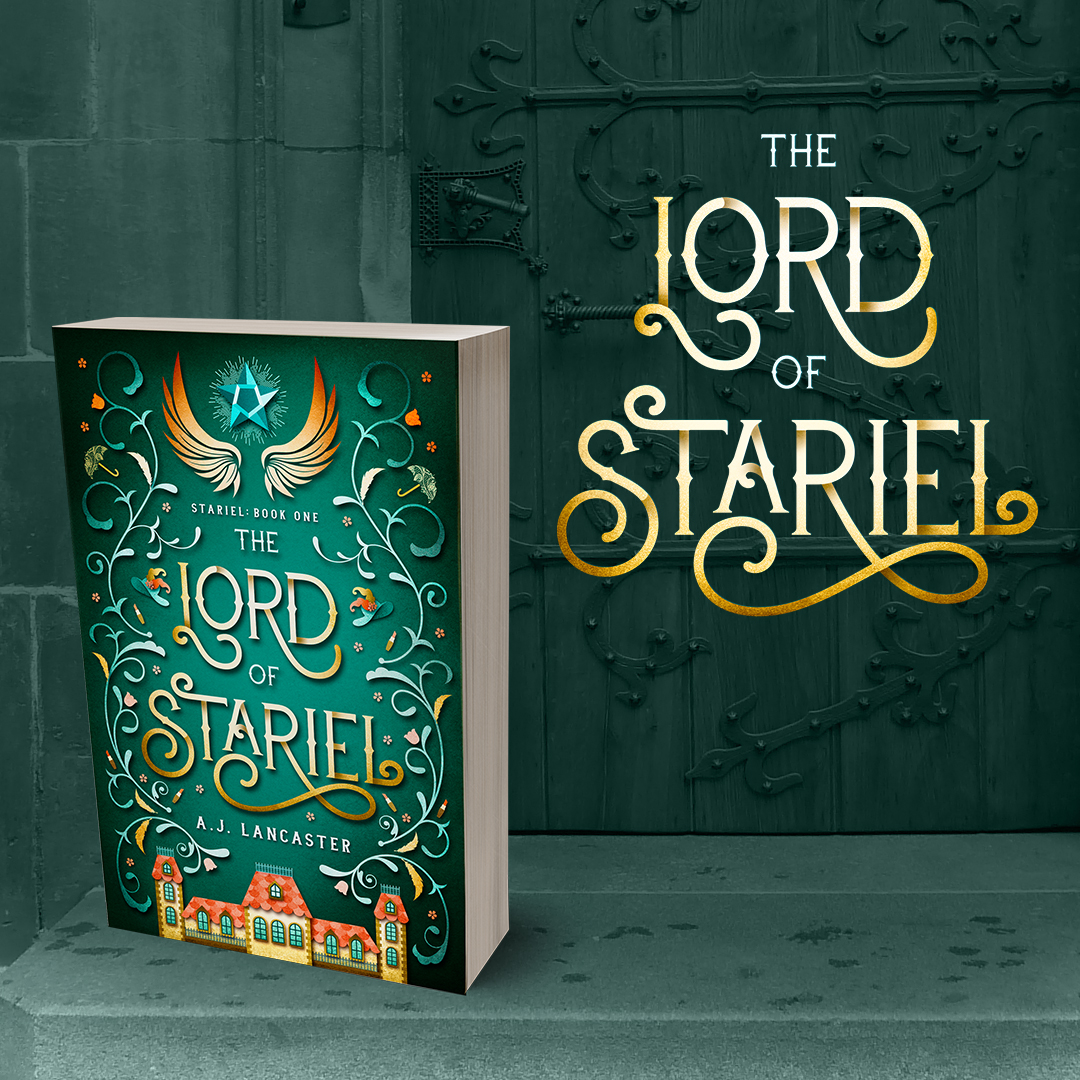
    Soooo… THE LORD OF STARIEL ebook is available to pre-order on Amazon!

    LordOfStariel_FC_R4 medium res
    It will release 1 November and I am COUNTING DAYS GUYS OMG. I am both incredibly excited to show it to the world and nervous for precisely the same reason!

    I think of books as a long, time-delayed conversation between authors and readers. You can keep your writing in the back of the wardrobe and never show it to another living soul. This has the advantage of keeping it safe from criticism, but it’s also a lot like talking to yourself. It also means the book is never truly finished, because there’s nothing to stop you fiddling with your wardrobe-book forever.

    It’s been a long journey, getting this series ready for release, and part of me still can’t quite believe that book one is really truly actually going to be published IN LESS THAN A MONTH.

    Where will the book be available to buy when it releases?

    Ebook

    In the long run, I plan to make my books available on all ebookseller platforms, but in the short run they will only be available on Amazon. This is due to Amazon’s exclusivity requirements for its subscription programme, Kindle Unlimited, which I plan to enrol my books in initially.

    Print

    You’ll be able to order books from your preferred bookseller of choice (I can recommend Book Depository for free international shipping). I’ll let you know when and where they’re available.

    A sneak peek

    I’ve also put the prologue and the first chapter up on the website. You can read it here. I plan to put a few more chapters up before release date, to psych myself up for it!

  • Writing in Cafes Review: Verve Cafe

    Writing in Cafes Review: Verve Cafe

    It’s currently the heart of winter, which in Wellington means cold rain and wind. Lots of wind. The cats have become increasingly snuggly i.e. interested in sharing body warmth.

    Wraith and Kestrel snuggled together

    I feel the cold easily. The ambient temperature of cafes has thus become even more important to me than usual.

    Wellington winter sunset
    I do like the occasionally spectacular winter sunsets though.

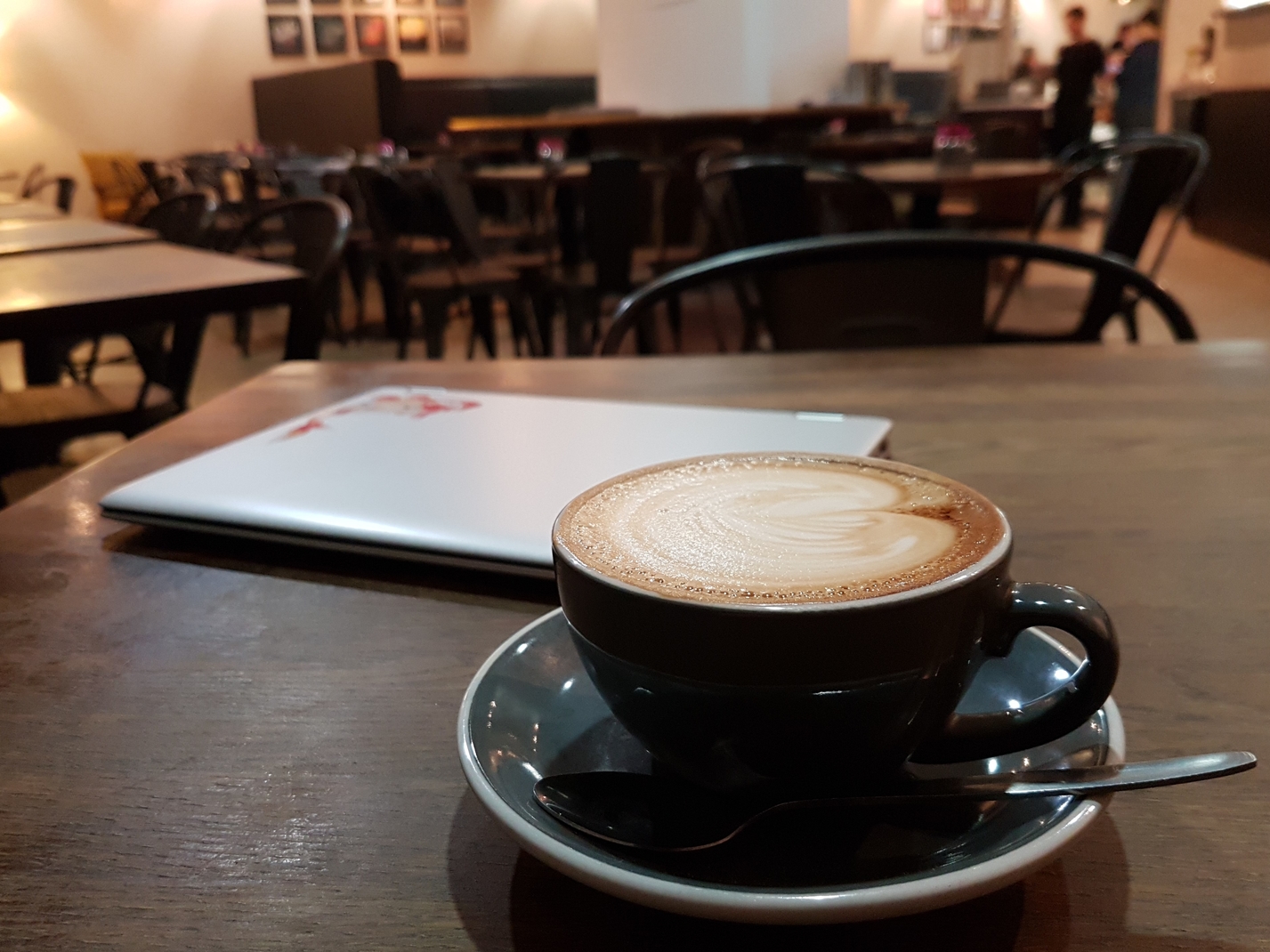
    For this reason, I’ve shifted my usual writing space from Mt Cook to Verve Cafe. Verve is located beneath an office/mall building in the CBD on Lambton Quay and gives the strong impression of being underground due to the complete lack of windows. I rather like the cosiness of this, but my friends have used words like “cave-like” to describe it.

    Reasons to go there

    Verve meets most of my key cafe criteria for writers, though the coffee quality is variable. There’s free WiFi, plenty of table space, comfy seats, many food choices. The staff seem relatively non-judgemental about my frequent presence as I desperately try to finish the last book in the Stariel Series.

    Verve cafe
    Verve cafe on a quiet Sunday afternoon in July.

    This is both a reason to go and not to go: The interesting playlists. I’m not sure who chooses them, but sometimes they exactly hit my preferences – one afternoon they played the entire soundtrack of Mamma Mia; another time, a list of nostalgic 90s pop hits. Other times, they choose a playlist diametrically opposed to my personal preferences, but YMMV (“I Whip My Hair Back and Forth” tests even my legendary ability to switch off my ears when I’m concentrating). Today is a good playlist day. As I write this, Tainted Love is playing in the background.

    Reasons not to go there

    If, you like to have some idea what the weather is doing before you go out in it, this is not the cafe for you, my friend. Sometimes I’ve been messaging people while inside Verve, suggesting we hang out, and they’re like: ARE YOU KIDDING? IT’S FREAKING BUCKETING DOWN AND GALE-FORCE WINDS OUTSIDE; I’M NOT LEAVING THE HOUSE.

  • Writing in Cafes Review: The Mt Cook Cafe

    Writing in Cafes Review: The Mt Cook Cafe

    One of my favourite cafes to write in at present is the Mt Cook Cafe, located in (astonishingly) the suburb of Mt Cook, Wellington. I may be biased in its favour because it’s within walking distance of my house and the barista knows me and my order on sight (one day I’ll order something different, I swear!). I hang out here a lot when I can’t be bothered dealing with busy central city cafes.

    Mt Cook Cafe main room
    Mt Cook Cafe, in the main space. Really need to take better cafe panorama photos that don’t just focus on Tiny Laptop…

    Reasons to go there

    The Mt Cook Cafe lives in what clearly used to be an old house, so it has this great homey vibe going on, with wooden floors and rustic-y tables. There’s also a side room in addition to the cafe’s main space, where I frequently hang out by myself in writerly solitude.  There is an outdoor area at the back that I have braved occasionally on one of Wellington’s rare, non-windy days.

    Mt Cook Cafe side room
    All set up to write in the side room of the Mt Cook Cafe

    The main space has enormous windows on two sides, drenching everything in light, which is also why I retreat to the darker (and cooler) side room in the summer months. My routine may change come winter.

    There’s also good free WiFi! #blessed

    They do both cabinet and menu food – prices are pretty standard for Wellington – and the staff have been super chill about me occupying table space for hours at a time. It helps that this is usually a quiet cafe. The only times I’ve seen it busyish are on weekdays at lunchtime during semester (it’s near Massey University) and during Sunday primetime brunching.

    Did I mention it’s within walking distance to my house?

    Reasons not to go there

    I have to be honest here: the coffee is pretty average (I’m sorry, nice barista man!).

  • Greetings 2018! Writerly New Year’s Resolutions

    Greetings 2018! Writerly New Year’s Resolutions

    So here we are, 2018, Day One, all fresh and shiny and full of potential. Rather like a new notebook (and who doesn’t love the crisp perfection of new notebooks?).

    In the Northern Hemisphere, New Year has a sort of starting afresh / emerging from the darkest hour seasonal parallel. Here in New Zealand, we’re in the middle of summer, so it’s more a sense of emerging from a time of respite (the summer holidays), ready to face the world again. Once more unto the breach!

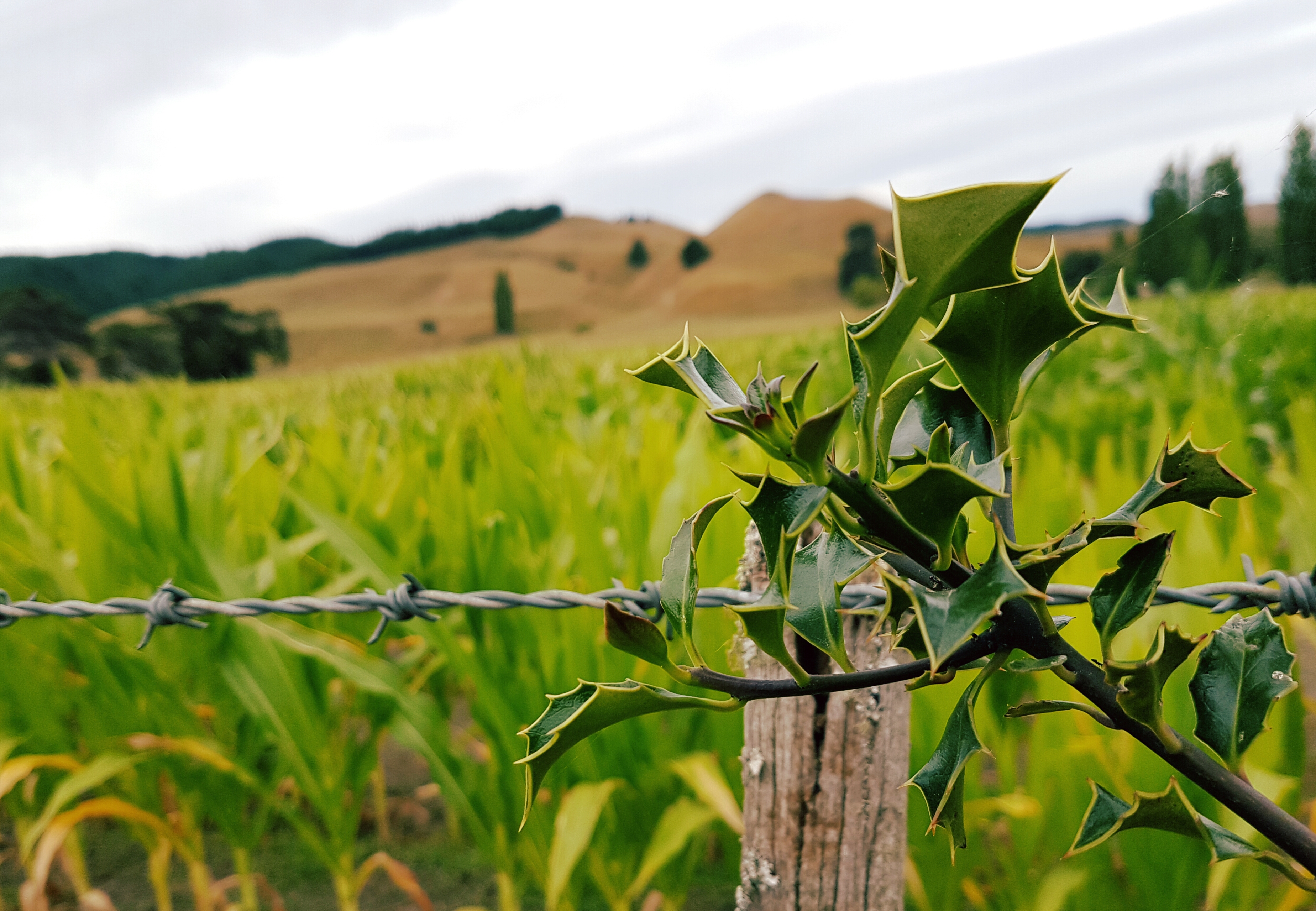
    Holly tree growing by the roadside
    I did find what I’m pretty sure is a holly tree growing along the roadside, which is kind of seasonally appropriate?

    What am I going to do with you, 2018? Well, 2017 has been a year of preparation, like a seed germinating beneath the earth. I wrote (and re-wrote) a lot of words in 2017; enough that I’m about half a book away from having my whole Stariel Series written. I intend for 2018 to be a year of spreading leaves aka publishing some books. I’m excited and terrified at the prospect. There’s a lot of work still to be done (not least of which is finishing the remaining half of Book 4): editing, covers, formatting, marketing and so on.

    It’s tempting to announce grandiose goals. On Day One, practically anything seems achievable by the end of the year. It’s also tempting to set goals based on what I see other writers doing. I will write twenty books! I will scale mountains and defeat ogres, armed only with weaponry constructed from hardbacks!

    But the truth is that writing is a very personal business. My goals have to align with my own values and my own reasons for doing this gig.

    So what do I value? I’ve done a lot of thinking, during these sleepy midsummer days, and what I want to achieve are books I enjoy reading and that I’m proud to put out into the world. It’s why I write, really – I want to finish writing any given book so I can have the pleasure of reading it once it’s written and polished and good enough*! This sounds a tad egotistical, when I put it like that, but one is supposed to be honest in New Year’s Resolutions, isn’t one?

    One should probably stop referring to oneself in the third person and get to the point.
    My goals for the year are thus, then:

    • Publish the Stariel books this year, but don’t sacrifice quality in the name of speed.
    • Read more books that aren’t regency romance novels this year, because it’s clearly starting to result in the use of too many third-person singular pronouns.

    *Deciding what constitutes “good enough” is, of course, as long as a piece of string.**
    **This is a malaphor, a blending of idioms. Aren’t malaphors just the bee’s pajamas?

  • The F word: Faerie, Fairy, Faery, Fayrie?

    The F word: Faerie, Fairy, Faery, Fayrie?

    I’ve been thinking a lot about a certain F word lately. You know the one:
    Fairy
    Faerie
    Faery
    Fae
    Fey
    Feyrie
    That one. Or rather, those ones. You see, my current series contains a lot of, um, F-things. And I need to decide which spelling to use.

    Now, you might think, given that I’m halfway through writing the fourth and final book in this series, that this decision would long since have been made. Ah, my sweet summer child. I am nothing if not indecisive. Besides, Microsoft Word has a global find-and-replace function, and I haven’t yet published any of the books. This means I’m not committed to any one spelling quite yet.

    However, I am going to have to become committed to a specific spelling shortly, mainly because the F-word looks like it’s going to appear in the title of Book 4. Which means it goes on the cover. Which means I need to nail down my spelling preferences before I organise the cover.

    So what’s the difference between all these words? To be honest, I’ve seen them all used interchangeably in fiction. Wikipedia has much the same attitude:

    Wikipedia_fairy_definition

    And Wikipedia doesn’t even mention the eleventy billion other options. Despite the consensus being, basically, “do what you want”, there are some differences in tone to consider. “Fairy” is more modern and evokes dainty tinkerbells; faerie has an archaic ring. Faery is an interesting mish-mash between the two. Fayrie belongs, I think, in the same category as vampyre and magyck aka who doesn’t love extra y’s in the middle of words? Phaeree? Now it’s just getting silly.

    Random selection of fairy titles
    A relatively random selection of book covers; consensus on spelling seems to be You Do You.

    I admit I’ve a fondness for “fairy” because mine are definitely not of the tinkerbell-sort, and the dissonance amuses me. But I also enjoy the eldritch connotations of “faerie” and aesthetically I quite like the appearance of “a” and “e” sitting next to each other (I shouldn’t have mocked the vampyres in the last paragraph – I have no high ground here at all, do I?).

    In the world of Stariel, I make a distinction between the Faerie Realm and the people who live in it – the fae. However, I haven’t quite been able to let go of the “fairy” spelling entirely – this is what uneducated humans call the fae. Is three different spellings in one novel being greedy?

    That said, enjoy an excerpt from the current draft of Book 1: The Lord of Stariel with all three spellings!

    “Am I to take it that my family are, in fact, fairies?” Hetta asked, pained.

    He burst into startled laughter. The sound filled the small room, warm and touchable, and Hetta gave her heart stern instructions not to soften in response. Remember how he’s lied to you!

    “Don’t you dare laugh! This entire tale is so fantastical that I wouldn’t believe a word of it if I hadn’t seen her change with my own eyes. How am I supposed to know what’s a reasonable question to ask? I’ve only known fairies are real for half an hour!”

    He wiped at his eyes. “Oh, I am sorry, Hetta. It wasn’t really so unreasonable a suggestion. It was your tone. You’re taking this much better than I’d hoped, despite my addle-brained telling of it.”

    “Well, get on with your addle-brained telling then.” Hetta eyed the whisky glasses on her desk, untouched from earlier. No, better not, she decided with regret. A clear head was required for this.

    He sobered. “To answer your question: no, the Valstars are not ‘fairies’. Or at least, not anymore. And I should correct your usage of terms. We are the fae; our land is Faerie.”

  • National Novel Writing Month 2017: Permission to be terrible

    National Novel Writing Month 2017: Permission to be terrible

    Every November there is a big and very nerdy international event of significance only to writers: National Novel Writing Month. The basic idea is to write 50,000 words between 1-30 November. It’s supposed to encourage people to stop procrastinating / agonising over every word and just write. Your 50,000 words don’t have to be any good; they just have to exist.

    I find this very fNaNo-2017-Participant-Badgereeing. The thing about writing is that when you first start doing it you’re generally terrible. And the only way to not be terrible at it is to let yourself continue writing whilst you are terrible at it. This can be difficult if you’re anything like me. In another life, I worked as an editor, which made me intensely conscious of my own writing’s terribleness. Trying to learn to write while a critic sat on my shoulder and agonised over every adverb went about as well as you’d expect.

    NaNoWriMo taught me how to turn off my inner editor. Editing is great, but the writing has to come first. You can’t edit a blank page.

    I don’t always do NaNoWriMo, but this year the timing coincides nicely with my schedule, which has me finishing Book 4 in my Stariel Series before the end of the year (Optimism! Yay!). Right now I’m frantically trying to nail down some semblance of plot, ready to start writing on 1 November.

    Wish me luck!